Monday, August 12, 2013

Democracy Prep, Harlem Village Charter Schools See Largest Drop in Test Scores

Math teacher Gary Rubenstein has taken a look at state test results and found some of the worst performance amongst those charter schools  most heavily promoted as being vastly superior to public schools.  Democracy Prep Charter School and Harlem Village Academy Charter School had some of the poorest results on 7th grade math.  Here's more detail from Rubenstein:
The most stunning example is the famed Harlem Village Academy which had 100% passing in 2012, but only 21% passing in 2013 for a 79% drop (you can see that sad dot all the way at the right of the scatter plot).  Democracy Prep Harlem Charter, run and staffed by many TFAers, dropped 84% in 2012 to 13% in 2013.  KIPP Amp dropped from 79% in 2012 to just 9% in 2013.  The Equity Project (TEP) which pays $125,000 for the best teachers had finally gotten some test scores they can brag about with 76% in 2012, but that has now sunk to just 20% in 2013.  The Bronx Charter School Of Excellence, which recently received money from a $4.5 million grant to help public schools emulate what they do, dropped from 96% in 2012 to 33% in 2013. 
The Democracy Prep results shouldn't be surprising to those who recall the earlier audit of Democracy Prep where DOE reviewers found “few lessons required higher-order thinking skills or deep analysis of concepts.” 

Wednesday, August 7, 2013

Shock Doctrine: five reasons not to trust the results of the new state tests

Dear parents: As you may have probably heard, the new state test scores were released to the press and they are disastrous. 

Only 31% of students in New York State passed the new Common Core exams in reading and math. More than one third -- or 36% -- of 3rd graders throughout the state got a level I in English; which means they essentially flunked.  In NYC, only 26 percent of students passed the exams in English, and 30 percent passed in math – meaning they had a level 3 or 4.  Only 5% of students in Rochester passed.  

Though children’s individual scores won’t be available to parents until late August, I urge you not to panic when you see them.  My advice is not to believe a word of any of this. 

The new Common Core exams and test scores are politically motivated, and are based neither on reason or evidence.  They were pre-ordained to fit the ideological goals of Commissioner King and the other educrats who are intent on imposing damaging policies on our schools.  

Here are five reasons not to trust the new scores:

1-     1. The NY State Education Department has not been able to produce a decent, reliable exam with a credible scoring system in at least ten years. That’s why there have been wild gyrations from year to year in the percent of students making the grade.  For example, 77% of NYS students were at level 3 or 4 in English in 2009; this dropped to 53% in 2010 and 31% now. The last two years of exams created by Pearson have been especially disastrous; from the multiple errors in questions and scoring on the 2012 exams (including the infamous Pineapple passage)  to the epic fail of this year’s tests – which were too long, riddled with ambiguous questions and replete with commercial logos for products like Mug Root Beer.  Top students were unable to finish these shoddy exams, and many left in tears and had anxiety attacks.  To make things worse, the exams featured reading passages drawn straight from Pearson textbooks which were assigned to some students in the state and not to others.

2-     2. For nearly a decade, from at least 2003-2010, there was rampant test score inflation in NY state, with many of the same people who are now supporting the current low scores claiming with equal conviction that the earlier, rising test scores showed that NY State and NYC schools were improving rapidly.  The state test score bubble  allowed NYC Mayor Bloomberg to coast to a third term, renew mayoral control and maintain that his high-stakes testing regime was working, when the reality  was that, according to everyone who was paying attention, the exams had gotten overly predictable and the scoring too easy over time.  At the same time as the state exams showed huge increases, scores on the more reliable national exams called the NAEPs showed little progress. In fact, NYC made smaller gains on the NAEPs than nearly any other large school district in the country during these years.  

3.     3. The truth is that the new cut scores that determine the different proficiency levels on the state exams – which decide how many kids “pass” or are at Level 3 and 4 -- are arbitrary and set by Commissioner King.  He can set them to create the illusion that our schools are rapidly improving, as the previous Commissioner did, or he can set them to make it look that our public schools are failing, as King now is doing, to bolster support for his other policies.

4.     4. The primary evidence that Commissioner King now bases his overly-harsh cut scores upon is that the results are mirror the percent of students who test “proficient” or above on the NAEPs.  Yet while the NAEPs are reliable to discern trends in test scores, because they remain relatively stable over time, the cut scores that determine the various NAEP achievement levels are VERY controversial. See Diane Ravitch on how the NAEP’s benchmarks are “unreasonably high”; or this article that reveals that even the National Academy of Sciences has questioned the setting of the NAEP proficiency levels, and how many experts believe that level 2 on the NAEPs – or basic -- should be used instead to estimate which students are on track for college:

Fully 50% of 17-year-olds judged to be only basic by NAEP ultimately obtained four-year degrees. Just one third of American fourth graders were said to be proficient in reading by NAEP in the mid-1990s at the very time that international assessments of fourth-grade reading judged American students to rank Number Two in the world.

In fact, by using NAEP levels as support for his cut scores, King is either confused or disingenuous about what these levels really represent.

5.     5. So why are King, Arne Duncan, Joel Klein and the billionaires like Bill Gates and Rupert Murdoch who are pulling the strings, so determined to prove that more that 69% of the students throughout New York State are failing?  This is the Shock Doctrine at work.  Naomi Klein has observed that when you scare people enough, it is easier to persuade them to allow you to make whatever radical changes you want, since the status quo will be perceived as so disastrous. In the case of these men, they would like to convince parents that their corporate agenda, including a steady diet of developmentally unsound standards, the Common Core’s rigid quota for “informational text” and overemphasis on testing,  and their favorite policies of closing schools and firing teachers based on test scores, expanding charter schools and online learning, data-mining and outsourcing educational services to for-profit vendors will somehow improve the quality of education in our state, even though there is little or no evidence for any of these policies.  

NYSED has even tried to persuade parents to accept their unethical plan to share the personal data of the state’s children with inBloom and for-profit vendors by claiming this will help ensure these students are “college and career ready.”  (By the way, as Politico reported last week, North Carolina became the fifth state to pull out of inBloom; now only New York, Illinois, and Colorado are still involved, and Massachusetts is sitting on the fence.) 

Joel Klein, who wrote an oped for Rupert Murdoch’s NY Post this morning in support of the new exams, appropriately entitled the The Good News in Lower Test Scores, now heads Amplify, Rupert Murdoch’s online learning division, which is the largest contractor for inBloom.  For Klein and Murdoch, the drastic fall in state test scores is indeed good news, because it will help them market their computer tablets, data systems, and software products to make more profit.  In the case of Pearson, the world’s largest educational corporation, more schools will now be convinced to buy their textbooks, workbooks, and test prep materials, as 900 NYC schools have now done – in hope that their students may do better on the Pearson-state exams, that may even include the same reading passages as happened this year.

Rick Hess, the conservative commentator at Education Week, revealed the motives behind the promoters of these exams in a column called the “Common Core Kool-aid”:

First, politicians will actually embrace the Common Core assessments and then will use them to set cut scores that suggest huge numbers of suburban schools are failing. Then, parents and community members who previously liked their schools are going to believe the assessment results rather than their own lying eyes… Finally, newly convinced that their schools stink, parents and voters will embrace "reform." However, most of today's proffered remedies--including test-based teacher evaluation, efforts to move "effective" teachers to low-income schools, charter schooling, and school turnarounds--don't have a lot of fans in the suburbs or speak to the things that suburban parents are most concerned about….Common Core advocates now evince an eerie confidence that they can scare these voters into embracing the "reform" agenda. 

My advice is not to let this ruin your summer or your view of your child’s school.  When you receive your children’s scores, do not allow the results to wreck their self-confidence.  These new Common Core exams and harsh proficiency levels are meant to scare parents.  

To achieve their ideological ends, politicians, billionaires, and educrats are not only willing to define your children in terms of their test scores, but also to redefine them as failures – to help them implement their mechanistic, reductionist, and ultimately inhumane vision of education.  It is all a high-stakes game, carried out by people with little thought about how these wild test score gyrations affect the self-esteem of the children whose fate they claim to care about.

For an eloquent critique of the callous thinking at work, please also read Carol Burris, NYS principal of the year, in today’s Washington Post, and Diane Ravitch, on the political motives of the people who are setting these standards.

Tuesday, July 30, 2013

The biggest scandal of Teach for America?


There has been much discussion and debate about how Teach for America undermines our public schools by encouraging the deprofessionalization of the teaching force, and “perpetuates systemic inequalities” especially in urban schools. In many districts, TFA has used its political clout to get its recruits hired, as in Chicago, while thousands of experienced teachers are being laid off.  Gary Rubinstein, a former TFA corps member, has been a fierce critic of the inadequate training that the organization provides.  Edushyster recently wrote that the TFA has become a primarily a “placement agency” to staff charter schools rather than public schools – and in the process is fueling the privatization movement. 
All the above is true; but in my mind, the most shocking aspect of the organization is how in many districts, including NYC, raw TFA recruits are assigned to special education classrooms almost exclusively --because this is the biggest shortage area.  See the recent Independent Budget Office report  on p. 24 – showing that 80 percent of TFA recruits in NYC public schools in 2010-11 were working as special education teachers; and 68 percent of Teaching Fellows (a similar program for mid-career recruits, run by TNTP).
That to me is the biggest scandal.  Instead of doing something to stanch the outflow of special education teachers assigned to those children who clearly need teachers with the MOST training and experience,  TFA and TNTP fill in the gap, year after year, with the least-trained recruits, who only stay one or two years and perpetuate the problem.
For all the endless rhetoric about teacher quality that issues from TNTP, about the need for more rigorous teacher evaluation and getting rid of sub-par teachers, they along with TFA are actively participating and benefiting from a system in which children with disabilities -- who require the most specialized instruction -- are relegated to the poorest-trained teachers.  The same phenomenon has been noted in Philadelphia – in which about 20 percent of the TFA recruits were assigned to special education classrooms in 2010:
Conventionally certified special education teachers in Pennsylvania must complete a comprehensive course of study combining a degree program at an accredited university and field experience in a special-education classroom.
For Joseph Ciesielski, a fully certified, third-year special education teacher at Olney Elementary, his studies helped him understand the laws governing special education as well as specific skills like writing an Individualized Education Plan (IEP). Ciesielski went through five years of schooling, 190 hours of classroom observation, and 12 weeks of student teaching.
He said he regrets that his training at St. Joseph’s University didn’t include “more outreach from the District and a mindset of ‘Let’s make it easier for you to come work here.’” Absent that push, many of his classmates headed for jobs in the suburbs, he explained.  But he said that his coursework on disabilities and how they affect each child’s learning is “very valuable” and “sometimes undervalued.”
TFA corps member Julia Cadwallender, now a second-year special education teacher at Spring Garden Elementary, had her advance training crammed into one summer.
Milwaukee also relies heavily on “alternatively certified” or “emergency-credential programs” like TFA and TNTP teachers to staff special education classes, and about one fourth of all its special-education teachers held emergency licenses in 2009. 
“…experts and advocates argue that a few weeks of preparation over the summer — and even less time for teachers who start training in the winter — isn’t enough to help individuals, regardless of their passion and motivation, deal with the often profound needs of special-education students.”
According to the Hechinger Report, about 12.5 percent of the TFA corps worked as special-education teachers in 2009.  I would suspect that the figure is even higher now.  How can the organization justify this?

Monday, July 29, 2013

The city's latest -- and outrageous -- attempt to avoid public scrutiny and parent input on class size


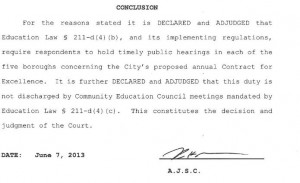
In June, in response to a lawsuit, New York State Supreme Court Justice Peter Moulton ruled that the NYC Department of Education is obligated to hold annual borough hearings on its Contract for Excellence (C4E) plan and include the transcript of these hearings when it submits its plan to the state – both of which the city has failed to do since 2008.  The law is clear that both borough hearings and presentations at Community Education Council meetings are required by the C4E statute passed by the NY State in 2007.  

On Friday, the city announced it will appeal the judge’s decision and deny parents the right to provide substantive input on its C4E plan, a plan that determines how more than $500 million per year is spent; and how much is allocated towards reducing class size.

Over the last decade, the Bloomberg administration has shown a profound disrespect for parent input and disinterest in following the letter of the law.  One of the most egregious examples of this is its refusal to adhere to a robust public process in regards its plan to reduce class, required in the Contracts for Excellence law.  Instead class sizes have increased every year of the past five, are now the largest in the early grades in 14 years.  Even higher class sizes are expected this fall.

Wendy Lecker, senior lawyer for the Campaign for Fiscal Equity project at the Education Law Center, explained:   “In June, a court ruled the state Contract for Excellence law mandates timely public hearings in all five New York boroughs so parents can react to City’s school spending plan for 2013-14.  These hearings give parents the opportunity to provide input on how vital education dollars are spent in their schools.  Chancellor Walcott has decided to appeal which automatically puts the court order on hold.  It's deeply disappointing that the Chancellor is wasting time and taxpayer money fighting parents in court rather than holding public hearings so the City's parents can be full partners in their children’s education.”

Shino Tanikawa, a plaintiff in the lawsuit and the president of District 2’s Community Education Council in Manhattan, said: "The 15 minutes or so we can devote to this at a CEC meeting is inadequate both in terms of the depth of discussion and the amount of public input parents are able to provide given this important issue – which makes borough hearings essential.  The court agreed with us that the DOE did not follow the law, yet rather than do what is right, the DOE continues to find ways to minimize the voice of parents.  When will parents be treated as meaningful partners in educating our children?"

Isaac Carmignani, co-president of the CEC 30 in Queens and another plaintiff, agreed: “We sincerely hope that the Department of Education looks to uphold the law rather than try to circumvent it.  The presentations CECs receive are sketchy as best; well-publicized borough hearings are required by law and DOE should hold them, to allow for full public scrutiny and input on the need to reduce class size and the DOE’s failure to do so.  Class size reduction is one of the top priorities of parents both in my district and citywide.”

According to Leonie Haimson, Executive Director of Class Size Matters, “It is outrageous that the city is determined to waste thousands of dollars just to try to delay the attention to their failure to reduce class size until Bloomberg is safely out of office; and to block parent input in this way.  Instead of achieving more accountability with the nearly $600 million NYC receives annually as a result of the Campaign for Fiscal Equity lawsuit,  we have less, as the administrators at Tweed have used this program as a slush fund and principals have used it to fill in the gaps resulting from the DOE’s egregious budget cuts to our schools.” 

This is just one of the many failures of DOE to be accountable for the spending of these critical funds.   There has been no public disclosure of NYC’s C4E plan -- either by the state or city -- since 2009. There has been no listing of the city’s approved class size reduction plan since 2009 as well.

The lack of accountability and transparency with hundreds of millions of dollars of state funds, meant to provide NYC children with their constitutional right to a sound basic education, is nothing short of appalling.


Here is an excerpt from the state law:

 4.  a.  A district's contract for excellence for the academic year two thousand eight--two thousand nine and  thereafter,  shall  be  developed through a  public  process,  in consultation with parents or persons in parental relation,  teachers,  administrators,  and  any  distinguished educator appointed  pursuant  to  section  two hundred eleven-c of this chapter.


    b. Such process shall include at least one public hearing. In a city   school  district  in a city of one million or more inhabitants, a public   hearing shall be held within each county of such city. 

A transcript of the testimony  presented at such public hearings shall be included when the contract for excellence is submitted to the commissioner, for review when making  a  determination  pursuant  to  subdivision  five  of  this section.


    c.  In  a  city  school  district  in  a  city  of one million or more  inhabitants, each community district contract for  excellence  shall  be  consistent with  the  citywide  contract  for  excellence  and shall be  submitted by the community  superintendent  to  the  community  district education council for review and comment at a public meeting.


 Here is the judge’s decision.


Wednesday, July 24, 2013

FAQ on inBloom Inc.: what is the state and your school district doing?

A shorter version of this FAQ was published in Schoolbook yesterday; please go leave a comment.  A pdf version of the below you can download  is here.  And please make your voices heard by sending a letter to your school board, your elected officials, and the Regents about this important issue.

FAQ on inBloom Inc.

Just as the federal government has been far from forthcoming about its surveillance and data-mining of ordinary Americans, education officials in New York and elsewhere have been remarkably secretive about their plans to share substantial amounts of students’ personal information with a corporation called inBloom Inc., and through inBloom, with for-profit vendors.
Though Class Size Matters and our attorneys urged the New York State Education Department to hold hearings about their participation in this data-sharing project in October 2012, then called the “Shared Learning Collaborative,” the state replied that this was unnecessary because they had “made significant efforts to inform the public …and to provide details about what the system would do and how it works.”  At the time, however, few if any parents or elected officials knew about their plans, and even now, many parents are not aware of the state’s intention to share their children’s most sensitive data with third parties. Moreover, the state has refused to answer many of our questions, including which data in particular is being shared, or respond to the concerns of parents.
Indeed, to this day much confusion persists.  An editor of a major New York daily recently wrote to a reader that they were unable to confirm that any personal student information was going to be shared with third parties, and that this was only a “rumor.”  Chancellor Walcott has repeatedly claimed at town hall meetings that “student information will remain confidential” and that “We will never, ever pierce student privacy.”  Yet over the course of the last six months, contrary information has slowly leaked out via public documents, the media and the efforts of parent activists throughout the nation who have demanded answers.  The following FAQ is meant to clarify what we now know about inBloom Inc. and their plans in New York and elsewhere in the country.

What is inBloom Inc.?  inBloom Inc. is a non-profit corporation, funded by the Gates and Carnegie Foundations to the tune of $100 million, created to collect personally identifiable student and teacher data from states and districts and share it with vendors. The data is being stored on a cloud run by Amazon.com, with an operating system created by Wireless/Amplify, a subsidiary of News Corporation, owned by Rupert Murdoch.  inBloom is planning to commercialize this data, with the agreement of states and districts, by offering it up to for-profit companies.  All this is being done without parental notification or consent.
What states and districts are participating?  According to its website, at least nine states originally planned to disclose their personal student data with inBloom.  After protests, four states have now officially withdrawn or claim they never intended to share data in the first place: Louisiana, Kentucky, Delaware, and Georgia.  In Illinois, schools in Bloomington and Normal are participating in data-sharing, and state officials say they intend to expand the program to 35 districts in 2014, including Chicago.  The district superintendent in Jefferson County, Colorado insists she will start sharing data with inBloom in the fall of 2014.  Massachusetts and North Carolina education officials, who were originally planning to upload student data for students who attend public schools in the city of Everett and Guilford County, respectively, now say they are reconsidering.  New York is currently the only inBloom client that is sharing student data from the entire state at this point, at least as far as we know.
What is the status of the program in New York?  According to the NYC Dept. of Education, the state has already transmitted student data to inBloom.  By the fall of 2013, according to NYSED, all districts are supposed to sign up for an “Education Data portal” (now euphemistically renamed EngageNY portal), which is a “data dashboard” accessible to teachers and school administrators that will pull data from the inBloom cloud.  The three companies with state contracts to receive personal student data for these dashboards are ConnectEDU (subcontractor CaseNex/Datacation), eScholar and NCS Pearson/Schoolnet. The NYSED fact sheet reports that these dashboards will be available for the school year 2013-2014; a more recent update from NYC DOE says that these dashboards and additional software “tools” will be ready “over the next year or so.”
What data is being shared with inBloom?  inBloom Inc. is planning to collect about 400 student and teacher data points, going back as far as 2006.  Many of these data points are highly sensitive and controversial.  (A full list is posted here; and an excerpt is posted here.) New York State officials have said they are sharing student names, test scores, home addresses, grades, disciplinary and attendance data, economic and racial status, and “program participation”, including “whether or not a student is entitled to special education, 504 indicator, English Language Learner educational services and accommodations.”  inBloom is also collecting teacher data, including names, addresses, social security numbers, and detailed employment histories, all linked to student test scores; whether New York is sharing this teacher data with inBloom is currently unknown. 
NYSED officials told DOE that they would post online a complete “data dictionary” in June 2013, or a list of all the data elements they are providing to inBloom.  Yet July is almost over and they have still not done so.  At the same time, the state is also encouraging districts to upload even more personal student data into the inBloom cloud, and to sign up with more vendors who will provide “interoperable” learning products and be able to access this information directly. 
For which students is the New York sharing data with inBloom?  The state has uploaded the data of all New York public and charter schools into inBloom cloud, according to DOE officials. 
Who has opposed this?  Parents, teachers, advocacy groups and privacy experts throughout the country have protested this unprecedented plan to commercialize children’s most sensitive information and share it with private corporations and for-profit vendors. The organizations opposing this data-mining include Class Size Matters, the Learning Disability Association of New York, Alliance for Quality Education, New York State Allies for Education, the Coalition for Educational Justice, the Massachusetts branch of the American Civil Liberties Union, the Center for Commercial Free Childhood, and Citizens for Public Schools. These groups have pointed out that a breach of this highly sensitive information, or its inappropriate use, could put children’s safety at risk, or mar their prospects for life. 
In New York, the NYC Comptroller, the Public Advocate, Assembly Speaker Sheldon Silver, as well as Cathy Nolan, chair of the Assembly Education Committee and Robert Jackson, the chair of the City Council Education Committee, and many other elected officials are on record against the state and city disclosing this data without providing parental notification or consent.  Many Assemblymembers and State Senators of both parties oppose this plan.
Is this being done with parental consent? And if not, doesn’t this violate legal privacy protections?  Though originally Stacy Childress of the Gates foundation wrote on the SLC website that “…Under federal law, school districts must manage and honor parent requests to opt out of programs that require the use of student data”, inBloom and Gates later reversed their position and said it would be up to states and districts to decide what their parental notification and opt out policies will be.  According to a spokesman for the NY State Education Department, parents have no right to opt out or consent, because "when parents register a child for school. They give up” the right to keep their children’s information private. The DOE now claims that according to state guidelines, “there is no formal provision for parents to opt their children out of inBloom.”
NYSED defends its position by saying that they are compliant with FERPA, or the Family Educational Rights and Privacy Act, the federal law that governs student privacy.  Yet FERPA’s regulations were rewritten and considerably weakened in 2009 and again in 2012, to facilitate the sharing of confidential student data without parental consent. The Electronic Privacy Information Center (EPIC) has filed suit in court against the US Department of Education, on the grounds that the federal government has rewritten and weakened FERPA’s regulations in a way that violates the language and original intent of the law.
What is the purpose of inBloom?  According to the DOE, inBloom, along with the software tools it will provide to vendors, “will allow educators and families to use data to understand student needs and target instruction.” Having access to this data will supposedly make it easier for vendors to create and market their “personalized learning tools”.  However, whether this will actually benefit students is unproven; as of yet, no online system of instruction or data analysis has been shown to improve student outcomes. In any event, there are multiple ways in which student data could be formatted in a uniform manner to make it easier for schools to acquire and operate software programs, without providing personal data to inBloom or any third party vendor.
What does inBloom have to do with the federal grant program called “Race to the Top” (RTTT)?  States received many points in their RTTT applications if they agreed to create “data systems to support instruction.” If they were awarded these funds, they were supposed to use them to build these systems. This appears to explain why NYSED is now requiring that any district that received RTTT funds sign onto one of the “data portals” of the vendors that will have data from the inBloom cloud. 
Yet many states that won RTTT funds are not sharing data with inBloom (for example, FLA, OH, MD, RI and TN) – and others that are did not win RTTT funds have signed up (CO, IL).  In addition, RTTT certainly did not require any state to outsource their entire student data system to a private company, as it appears New York has done.  In any case, whether or not a NY district received RTTT funds, its student data is being uploaded by the state into inBloom anyway.
Why does the state need to share this data with inBloom and/or vendors? Don’t many schools have “data dashboards” already?  Yes, many schools already have contracts with companies to produce data dashboards, separate from inBloom.  Yet school officials we have spoken to in NYC and the rest of the state insist that the current contracts they have do NOT allow vendors unfettered access to any personalized student data.  Instead, these companies provide them with the software and the schools populate the data themselves. They also say the only time a vendor now might gain access to the data is if there is a technical glitch or virus, and then the vendor would have to be given a temporary password to go in and fix the problem, under strict security conditions. Presumably, once the inBloom plan is fully implemented and new contracts with vendors are signed, access to the data will no longer be under the strict control of individual districts or schools.
Some schools view the list of three companies provided by the state as unnecessarily restrictive, limiting their autonomy and squeezing out other companies that might have a better product. Other districts do not currently use data dashboards and see no need for them.  But none of the district or school officials that we have spoken to believe there is any need for the sort of unfettered data sharing that is occurring with inBloom, under such unrestricted conditions, and believe that this represents a serious threat to the privacy and security of their students. 
Didn’t ARIS provide data dashboards to NYC schools?  Yes, the DOE spent $100 million building the ARIS data system that was supposed to produce many of the same benefits to teachers and students that are now being claimed that inBloom will provide.  In fact, Sharren Bates, the Chief Product Officer of inBloom, was formerly in charge of the ARIS project for NYC DOE.  Yet ARIS is now widely considered a failure, and according to independent studies, is rarely used by teachers or parents.  In any event, the fact that DOE has said it will allow ARIS to lapse as soon as the new data dashboards are operable, “alone says a lot about their mismanagement”, according to a NYC principal, who added: “Ideally, had ARIS been built properly we would not be paying any vendor fees and schools could use that money in other ways to support students.”
How much will inBloom cost?  Starting in 2015, inBloom says it will charge states and districts two to five dollars per student per year for storing the data and making it accessible to vendors.  These fees do not count the additional costs charged by vendors if districts sign up for other software or hardware receiving data from the inBloom cloud. As of now, it is uncertain whether New York state or individual districts will be obligated to pay these fees; or if a district will be able to pull out of inBloom if it chooses not to cover the costs.
Is the data being sold?  Currently, New York State and New York City are providing this very valuable personalized data to inBloom for free, and they, as well as inBloom, insist that the data will never be “sold.”  However, inBloom’s board members and funders have said that inBloom is “exploring cost recovery partnerships with select vendors for the services that it provides.”  If not selling the data, this could be likened to renting it out.
What about the security of the inBloom cloud?  Though inBloom and NYSED claim that the cloud storage used in this project “exceed the security measures in place currently in most states and school districts,” this is highly debatable.  Most districts and states keep personal student data on site, either in paper files or on localized systems,  and do not upload it onto offsite clouds where it can be more easily hacked into. 
Recently, the personal information of 50 million customers of Living Social, a discount company, was breached, after a cyber-attack on the Amazon.com cloud on which it was stored. A survey of technology professionals found that 86% do not trust clouds to store their more sensitive information. inBloom Inc. has itself warned that it “cannot guarantee the security of the information stored...or that the information will not be intercepted when it is being transmitted.” The more personalized data that is aggregated on a cloud the more attractive it is to hackers; and the more it is transmitted to vendors the more likely it is that it will breach or be used in an unauthorized manner.  Disability and health data is considered particularly sensitive, and cannot be shared with third parties without parental consent if this information is contained in a child’s medical records rather than their educational files.
The state and DOE claim that school districts share personal student information “all the time.”  Is this true?  Unclear, but if so, it should never have happened and cease immediately. DOE has cited two examples in which NYC currently provides personal student information with vendors without consent: First, busing companies “receive a limited subset of data for special education students who require to be picked up from their home….the student’s name, home address, and other information about the student that is needed to provide the required services (e.g., knowing that a non-ambulatory student would require a wheelchair) in a smooth manner.”
Yet busing information is on a student’s IEP, or individualized education plan, which requires a parent’s signature, so it’s not clear this is provided without implied consent.  In any event, it would be relatively simple for parents of children with disabilities to sign a separate consent form, giving their permission for this information to be shared with busing companies for the purpose of allowing them to transport their children to school.
The other example that DOE has offered is their disclose an array of personal data to CTB McGraw Hill, including “student ID, student first name, student last name, school location code, school name and network, grade level, class, date of birth, demographic information, and indicators of Individualized Education Plan and English Language Learner status.”   According to DOE, this is done “so that the company can upload it into the online tools teachers use to view and analyze students’ results on formative assessments.“
Unlike the busing example, there is no need for the company to be provided with this level of sensitive detail for any student, and it should cease.  Teachers can view and analyze individual student test scores without this company receiving any personalized information about their students. In any case, the inBloom operation goes far beyond these two examples, and is unprecedented in scope, as it will aggregate a huge amount of highly sensitive data, store it on a vulnerable cloud, with the explicit purpose of commercializing the data and making it available to as many vendors as possible, while insulating itself from any liability for breaches.
What don’t we know?  Many unanswered questions remain. NYSED officials have not yet revealed what exact student data is being shared with inBloom, and for many years back in time.  We don’t know if the data of students in preK programs is also being shared, either those run by districts or in CBO’s, or if student information at state-funded, non-public special education schools is being disclosed. They have not told us whether they are also sharing teacher data, and/or who will have to pay for inBloom’s “services” starting in 2015.  They haven’t explained who will be financially or legally responsible if the data breaches, though DOE has said the state and/or vendors would be liable. They haven’t said whether districts can choose to pull their student data out of inBloom in 2015 or at any other point. The Memorandum of Understanding signed by the Illinois State Education Commissioner allows its districts to pull their student data out whenever they choose, but New York’s contract contains no such provision.
What can parents do to stop this data-sharing? Two bills to protect student privacy passed the State Assembly in the last session.   A.6059A would have blocked re-disclosures without parental consent, and A.7872A would have allowed parents the right to opt out of the state or district being able to share their child’s data with third parties. Though a similar bill was introduced in the Senate, and had strong bipartisan support, it did not pass.  In any case, parents, advocates and concerned citizens should put pressure on their legislators, their school boards, Commissioner King and the Board of Regents to pull all student data out of inBloom as soon as possible. 
We have drafted a sample letter you can send your school board, with a copy to your Superintendent, your Board of Regent member, and your legislators. The letter urges your school board to hold a public meeting about their data sharing plans, and asks them pertinent questions about their current practices concerning the disclosure of personal student information to third parties without parental consent.  

Prepared by Leonie Haimson, Class Size Matters, 7/23/13


Selected reading list
(For more articles, check out our inBloom/privacy newsclips):

New York City Department of Education. “Supplemental Information Regarding Privacy and Security of Student Data in inBloom.” (2013) http://schools.nyc.gov/NR/rdonlyres/20C87CC4-0C95-4DBE-A5BE-12219A5015F8/0/supplementalinformationregardingprivacyandsecurityinbloom.pdf


New York City Department of Education. “Frequently Asked Questions about Privacy and Security of Student Data in Education Data Portal.” (2013) http://schools.nyc.gov/NR/rdonlyres/9720D65F-2287-451C-92DA-BD61B92829D1/0/PrivacyandSecurityofStudentDatainEDPFAQ_041262013.pdf

United States Department of Education. “Family Educational Rights and Privacy Act Regulations.” (January 2009) http://www2.ed.gov/policy/gen/guid/fpco/pdf/ferparegs.pdf

Gerry Grealish. “Living Social’s Data Breach – The Importance of Encrypting or Tokenizing Personally Identifiable Information.” (May 7, 2013) http://www.perspecsys.com/living-socials-data-breach-the-importance-of-encrypting-or-tokenizing-personally-identifiable-information/
Leonie Haimson.  “Video and news from our explosive Town Hall meeting on student privacy.”   NYC Public School Parent Blog (April 30, 2013)http://nycpublicschoolparents.blogspot.com/2013/04/video-and-news-from-our-explosive-town.html

Wendy Lecker. “Private data on children must stay that way.” Stamford Advocate. (May 31, 2013) http://www.stamfordadvocate.com/news/article/Wendy-Lecker-Private-data-on-children-must-stay-4566834.php
Jason Lewis, “Who is Stockpiling and Sharing Private Information About New York Students?”  Village Voice. (March 22, 2http://blogs.villagevoice.com/runninscared/2013/03/data-sharing.php
  
Adina Lopatin. “Town Hall Meeting regarding Student Policy Data and inBloom.” (May 22, 2013) http://www.classsizematters.org/wp-content/uploads/2013/06/Adina-Lopatin-inBloom-Follow-Up-Q-A-055222013.doc

Stephanie Simon. “K-12 student database jazzes tech startups, spooks parents,” Reuters. (March 3, 2013).   www.reuters.com/article/2013/03/03/us-education-database-idUSBRE92204W20130303

Stephanie Simon. “School database loses backers as parents balk over privacy,” Reuters, May 29, 2013. http://www.reuters.com/article/2013/05/29/us-usa-education-database-idUSBRE94S0YU20130529

Valerie Strauss. “An exchange on controversial $100 million student database.” (June 12, 2013) http://www.washingtonpost.com/blogs/answer-sheet/wp/2013/06/12/an-exchange-on-controversial-100-million-student-database/

Ken Wagner. “Memorandum on Education Data Portal and Common Core Implementation.” (March 2013) http://usny.nysed.gov/rttt/data/edp-memo.pdf

Audrey Watters. “More Details on InBloom’s Plans for Student Data.” (April 4, 2013) http://hackeducation.com/2013/04/04/inbloom-more-details/