Tuesday, July 12, 2016

List of NYC schools with elevated lead levels; and follow-up questions for DOE

Update:  Beth Fertig of WNYC/Schoolbook writes today that the DOE says "At every location where elevated levels persisted after a second test, the city said it turned off the source of the water and then started making repairs or replacing the fixtures."  

The Mayoral spokesperson seems to imply something different, saying that "In the rare instance of any elevated sample, [emphasis mine] relevant fixtures and piping are replaced to the wall, and retested out of an extreme abundance of caution."   This would imply that all 509 schools with elevated samples will be, not just the 153 in which the lead levels remained elevated after flushing, but Beth emailed me that she believes that they were speaking of only the 153 schools.   In addition, as I noted belowVirginia Tech lead expert, Marc Edwards was quoted as now recommending a minimum of testing every three years - as opposed to the DOE's five year testing cycle.  So three of my questions below remain unanswered.

Ben Chapman of the Daily News wrote about the latest on NYC school water today here. It turns out that when all schools were finally tested, 509 had elevated levels of lead in at least the first sample; though in most of these schools, the levels diminished after flushing the pipes. 

It appears that 153 schools still had elevated lead on the second draw -- after sorting the list of NYC schools with elevated lead samples here .  The worst off seem to be PS 14 in D24 in Queens, with 12 elevated samples in the first draw, and 7 in the second; and PS 127 in D30 with 10 elevated samples in the first draw and 6 in the second. But check to see if your child's school is on the list.

What is good is that they say they are testing all schools now, including those built since the 1980's, contrary to DOE's original intention.  Until the Flint lead controversy occurred, the vast majority of NYC schools hadn't been tested for lead in over ten years, as pointed out by Schoolbook on March 29 -- contrary to the NY Times article which claimed a few days earlier that "All schools’ water is regularly tested."  

The DOE now says that every school will be retested for lead every five years; which runs contrary to the recommendations of the Virginia Tech lead expert, Marc Edwards, who exposed the Flint water tragedy, and recommends annual testing for lead -- at least in all schools built before 1986.   

The below DOE press release claims that "Our protocol exceeds EPA protective guidance and involves regular flushing or fixture replacement." Actually EPA guidance calls for flushing as a short term measure, and replacements of fixtures or pipes as a permanent remedy. The DOE press release below begs the following questions:
  • In which schools is the DOE going to replace the pipes and/or fixtures?
  • What oversight will be used to ensure that regular flushing will occur in the rest of schools?
  • Should parents be concerned about the ten years or more in which there was lead in the water in these schools and no flushing?
  • Should parents have their children tested for lead who attended these schools?  
Let's hope someone in the media asks DOE these questions.  


FACT SHEET: LEAD TESTING IN NYC SCHOOLS' WATER SUPPLY


NYC WATER OF HIGHEST QUALITY, WITH EXTENSIVE MEASURES MEETING OR EXCEEDING ALL EPA RECOMMENDATIONS TO PROTECT STUDENTS AND FACULTY

Less than 1 Percent of Final Test Results for NYC Schools Tested Positive for Lead

This latest round of testing from the DOE, in partnership with DOHMH and the EPA, reaffirms that our efforts are highly effective at keeping the water in our schools safe. Of the 112,584 samples taken, only 1.0% were found to have elevated levels that exceeded EPA guidelines on the first draw (the first water out of the tap, which would include stagnant water); just 0.19% of samples were positive second draw samples. 

The Department of Environmental Protection (DEP) has invested more than $10 billion over the last decade to maintain and improve NYC's water supply infrastructure; DEP also tests the city's water over 500,000 times each year at various points throughout the system. Between 2008 and 2010, DEP worked with the Department of Education (DOE) and other City agencies to identify and remove lead service lines to schools and other municipal buildings.

This year, DOE has tested the water in every public school building, regardless of whether it was built before or after the lead ban in the 1980s.

Since 2002, any building that has had even one outlet (e.g., a sink or a fountain) with levels that exceeded EPA guidance has been put on an extensive DOHMH protocol based on EPA recommendations, which includes some combination of equipment replacement, weekly flushing, and more to ensure the safety of students and staff.

The protocol is proven to protect students and faculty for two key reasons:

·         The vast majority of elevated levels are found on first draw. Weekly flushing on Monday mornings or after school vacations - the only times at which water has been sitting in the pipes for those extended periods - is proven to quickly eliminate any elevated levels and ensure the water students and faculty drink is safe.

·         Positive tests on second draw- after water has been running-are rare. If they do happen, they can almost always be linked to a specific piece of equipment which is immediately removed, repaired, or, in rare cases of bathroom sinks, designated as a handwashing only (no drinking) station.

"Families can rest assured that water in school buildings is of the highest quality and is safe for students and staff to drink," said Schools Chancellor Carmen FariƱa. "Schools are following the aggressive flushing and remediation protocols that the DOE has had in place for years, and we continue to update families and school staff throughout the process."

"New York City's tap water is of the highest quality, and not a source of lead poisoning," said Health Commissioner Dr. Mary T. Bassett. "Parents should be assured by the joint efforts of our two agencies to increase transparency and accountability. Elevated lead test results in water are most often attributable to older internal plumbing and fixtures. When that occurs, schools sites implement corrective measures to reduce lead levels. Our protocol exceeds EPA protective guidance and involves regular flushing or fixture replacement. Flushing removes any built up lead in stagnant water."

This latest round of testing once again reaffirms that our protocols are protective and effective. NYC Water is of the highest quality, with extensive measures in place that meet or exceed all federal Environmental Protection Agency (EPA) recommendations - measures that did not exist in other cities around the country that are now facing concerns about lead.

In fact, the number of children in New York City with lead poisoning has declined 80 percent since 2002; and in 2015, the Department of Health and Mental Hygiene (DOHMH) referred, based on blood lead test results, just 45 of the 1.1 million public school children in NYC to the DOE for investigation. In all 45 cases, EPA-certified consultants and the City examined every classroom and home and took appropriate action as needed; there were no cases in which water was determined to be the source of elevated lead levels.

Results for individual schools can be found on a first-of-its-kind web portal that allows families and faculty members to track the results of the lead testing and protection measures that have been in place in public schools since 2002. Final test results are immediately shared with families and posted on the DOE's website. Letters backpacked home to families with details regarding the results are available in nine languages, as requested by school staff, and principals are available to address any questions that may arise. In the rare occurrence that a school has elevated results, families receive a second letter with updates once remediation and follow-up testing are completed.

DOE, in partnership with DOHMH, will continue to test schools based on DOHMH and EPA recommendations - in fact exceeding the frequency of testing recommended in the EPA's guidance. For the limited number of buildings that had even one outlet above recommended levels in a previous test, this includes continued implementation of the DOHMH protocol and regular retesting thereafter - with three-draw samples taken within six months or one year of the initial tests to continue to confirm the effectiveness of flushing, and regular retesting every two years thereafter. Schools that have not tested positive for elevated levels will still be retested every five years. Schools with construction that could disturb, vibrate, or shift plumbing and/or fixture will be immediately retested. The City is also offering free guidance and testing to private nonpublic schools.

Thursday, July 7, 2016

New nationwide poll shows parents find standardized tests of little value

High Achievement NY put out a press release trumpeting a new poll from Achieve -- both organizations funded by the Gates Foundation to promote the Common Core and testing.  Though the poll did find that parents are concerned that their children may not be sufficiently prepared for college and career, there is little to show that the Common Core standards and more testing leads to better preparation. 

The results of the poll itself is interesting and shows growing discontent with the testing regime.

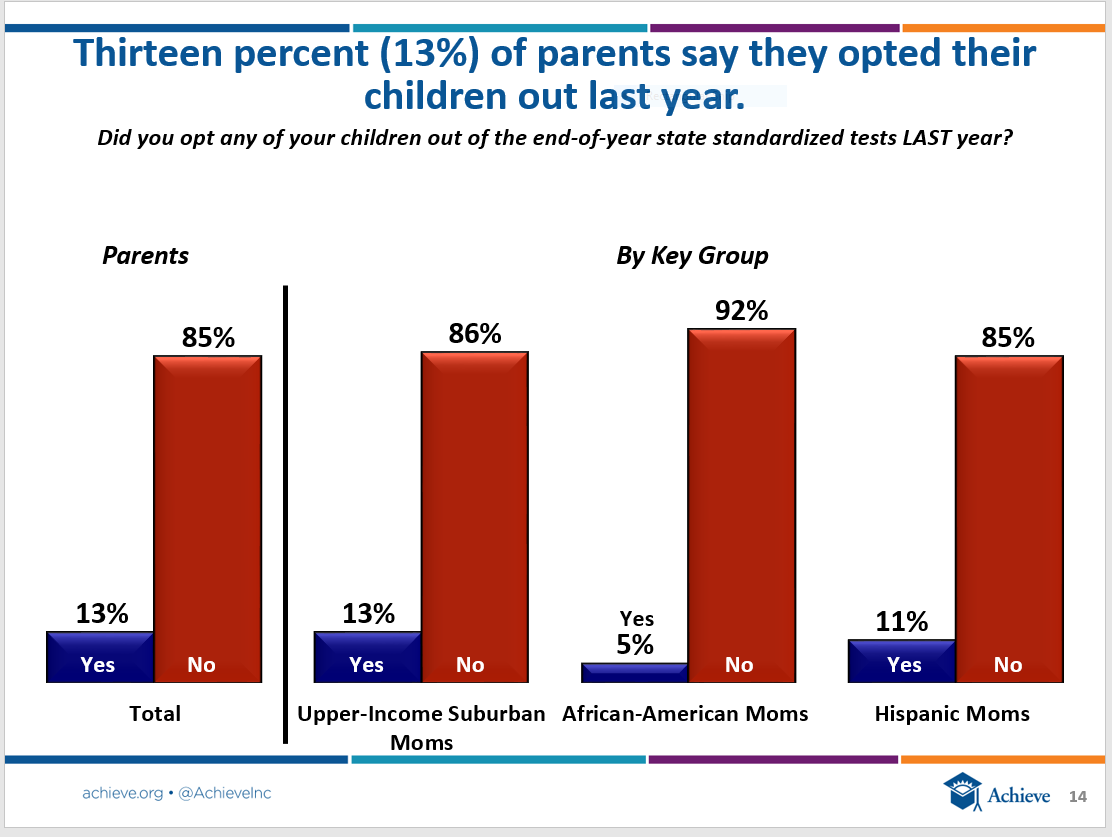
See this slide, revealing that 13% of parents opted their children out of standardized tests last year.


Despite lower rates overall than upper-income suburban Moms (their words, not mine) African-America and  Hispanic Moms intend to opt their children out in greater numbers next year -- with the number of African-American mothers nearly doubling.


Also, respondents give a variety of reasons for opposing standardized testing, with 49% saying the exams do a poor job capturing their children's true abilities, and 48% say that the exams yield no positive benefits to children taking the exam. Especially interesting is that 53% of African American  Moms say their children are subjected to too many tests. 

 Altogether, these responses must be very discouraging to Gates et. al. which has spent millions of dollars funding organizations and media outlets to spread the message that parents who opt out of Common Core exams are selfish, mean-spirited and misguided.


Monday, June 27, 2016

Primer on Purchasing Methods Employed by DOE

The purpose of this post is to provide some explanation of how NYC public school contracts are presented to the Panel for Educational Policy for approval. 
  
To secure internal DOE and PEP approval, the DOE prepares a document summarizing the contract called a Request for Authorization (RA).  The RA includes basic facts about the contract: vendor, contact info, term, funding source, estimated amount, whether the contract is retroactive, as well as a description of the purpose and a discussion.  Negative findings about the vendor reported through the City's VENDEX system or other sources are included in the discussion. 

The RAs for each PEP meeting are packaged up in a single large pdf file and published online.  

While the documents are mostly self-explanatory, the different procurement methods warrant some explanation:
  • competitive sealed bidding (RFB)
  • request for proposals (RFP)
  • multiple task award contracts (MTAC) 
  • listing application
  • expedited competitive solicitation;
  • sole source goods procurement
  • negotiated services 
  • emergency purchases
  • simplified procurement
  • purchases through government contracts
  • demonstration projects for innovative products, approaches, or technologies;
  • innovative procurement methods; 
  • government-to-government purchases
  • consultant contracts with individuals
Here's a brief explanation of the major types sourced from the full policy document with some editing for readability:  (For more information see the purchasing policy and procedures defined by the DOE and approved by the Panel for Educational Policy)

Competitive Sealed Bid (RFB)

Competitive sealed bidding is the preferred method of procurement where specifications can be made sufficiently detailed and exact to permit award of a contract to a responsive and responsible bidder solely on the basis of price, except where award on the basis of best value is in the DOE’s best interests as provided for in Section 3-02(o)(1)(ii) of the procurement policy.


Request for Proposal (RFP): 

The Request for Proposals (RFP) method should be utilized when it is not possible to fully detail the scope of work to be provided, and when it is necessary to evaluate proposals on a number of factors including experience, staffing, suitability for needs and quality of vendor, in addition to price. Contracts are awarded to the vendors whose proposals are determined to be the most advantageous to the DOE. 


Multiple Task Award Contract Process (MTAC):

A contract specifying specific services at set prices distinguished by: (1) multiple vendors are awarded contracts for the same or similar services; (2) the contract does not specify a quantity of services or, where applicable, a location or specific recipient of the services to be provided (instead the solicitation or contract may indicate, for example, that students in certain grades are targeted recipients); and (3) usage of the contract is through a streamlined process for placing orders for the performance of tasks during the period of the contract. MTAC’s are awarded where there is a demand for a service among multiple schools/offices, it is necessary to contract with multiple vendors to meet the demand, and it is efficient to offer schools/offices a choice of service providers at specified unit prices and a streamlined ordering process. 

Because the final decisions on how much of an item to buy and from which vendor included in an MTAC is the prerogative of schools or departments within DOE, the estimated amounts provided on the RAs are based on prior years of purchasing and anticipated volume for new vendors.

Listing Application

A listing application is used to purchase content provided directly to students, materials that are available only from the publisher, artistic performances, and admission to programs offered by cultural institutions. 

It may also be established for: (1) presentations or workshops where the cost is incidental to the entire expense of the contract and which are specifically geared to explain the methodology of a specific published/copyrighted item, or (2) admission to a cultural institution program that includes workshops or presentations where the cost is incidental to the entire expense of the contract and which are considered teaching tools that will enhance the use of the original materials, performances or programs purchased.

These materials and services are considered unique as they can not be purchased
by open, competitive means. 

Similar to MTAC, amounts on listing applications are estimated.


Expedited Competitive Solicitation

Expedited competitive solicitation may be utilized when time constraints require procuring the services of a vendor quickly and use of another source selection method would not be practicable and/or feasible. Under such circumstances, if there is a reasonable belief that competition exists in the marketplace, an expedited competitive solicitation process may be employed. 


Sole Source Goods Procurement

Sole source goods procurement shall be used for the purchase of goods when there is only one source through which the goods can be purchased and when no other product is available in the marketplace that meets the same or substantially similar requirements of form, function and utility. Sole source  contracts for goods may include installation, maintenance or other services associated with the proper use or operation of the goods where it is beneficial to the DOE to include such services in the contract. The price, terms and conditions shall be achieved through negotiation between the DOE and the vendor. 


Negotiated Services

Negotiated Services shall be used when other methods of procurement are not practical or possible and it is in the best interest of the DOE to procure services under the circumstances specified herein. The award of a contract shall be based upon a combination of cost, quality and efficiency. 


Emergency Purchases

An emergency condition is an unforeseen danger to life, safety, property, or a necessary service. The existence of such a condition creates a need for goods, services or construction that cannot be met through normal procurement methods. An emergency procurement shall be limited to the procurement of those items necessary to avoid or mitigate danger to life, safety, property, or a necessary service.


Simplified Procurement

Simplified procurement is a streamlined method of competitive procurement for purchases less that $15,000. Public notice of solicitation and award, vendor protests, and written notice to the low bidder or offeror of non-responsiveness shall is not required.  Written requirements and competitive bids are still required.

Sunday, June 26, 2016

Please help us stop John King's "test and punish" ESSA regulations

John King, now US Education Secretary, is up to his old tricks and is trying to eliminate all the flexibility that Congress intended the new law called ESSA to achieve.  He instead wants to require that states punish schools with high opt out numbers and to impose a single grade on all schools-- which NYC wisely moved away from.  Other problems with the proposed regs are below. 

Please take a minute to leave a comment on the US ED Gov site on these proposed regs by using the NPE suggestions below -- and click on the link to send a letter to your members of Congress; if you can, try to edit the letter a bit so it doesn't register as spam.   thanks! 


We urge you to take a stand against the proposed regulations drafted by U.S. Secretary of Education John King for implementing the accountability provisions of the Every Student Succeeds Act (ESSA).  Although the intent of ESSA was to put an end to the “test and punish” regime of NCLB and give more flexibility to the states, in some ways the draft regulations are even more punitive and prescriptive than under NCLB.

For example, although ESSA permits states to pass laws allowing parents to opt their children out of taking the state tests, the draft regulations would require states to harshly punish or label as failing, schools in which more than 5% of students opt out.

The regulations would also require that every public school in the country receive a single grade--based primarily on test scores and other strictly academic factors -- even though the law properly leaves it up to the states to devise their own grading systems within certain limits. This would impose simplistic and damaging school grades that have already been found defective in many states and districts across the country.


In short, these proposed regulations would micro-manage the ability of states to create their own accountability systems, and take away the opportunity for parents and educators to have a real voice in their school accountability system.

It is imperative that we push back now while there is still time to change course. We need you to do two things as soon as you can:

1.     Please cut and paste the comments below the line into the area for comments on the US Department of Education website, which you will find by clicking here – or revise them according to your liking.

2.     Complete our Action Alert and send a letter to your own representatives urging them to block these destructive regulations. We make it easy to do! Just click here.

It is critically important that you take the time to try to improve these regulations, before it’s too late – and stand up for our public schools and students.

Although the comment period is open until August 1, we ask that you take action as soon as possible and preferably by Tuesday, June 29 because the Senate is questioning Sec. King on Wednesday. Thanks for your help!
Carol Burris, Executive Director of NPE
___________________________________________________________
Please cut and paste the text below here, or revise if you prefer.
 
I oppose the following proposed regulations as contrary to the language and spirit of ESSA and because they will impose damaging and overly prescriptive mandates on our public schools.
In each case, the US Department of Education is foisting its own preferences while tying the hands of states, districts, parents, and educators to devise their own accountability systems, as ESSA was supposed to encourage. Specifically:

1. Draft regulation 200.15: This would force states to intervene aggressively and/or fail schools in which more than 5% of students chose not to take the state tests. This violates the provision in ESSA recognizing “a State or local law regarding the decision of a parent to not have the parent’s child participate in the academic assessments”


Recommendation: This regulation should be deleted. States should be able to exercise their right to determine what measures should be taken if students opt out, free of federal intrusion.

2. Draft regulation 200.13
The law requires states to create a growth score as an indicator for elementary and middle schools. Secretary King has inserted “based on the reading/language arts and mathematics assessments” into the regulation. This would prevent states from creating their own measures of student learning across the curriculum, based on factors other than standardized test scores.

Recommendation: The language “based on the reading/language arts and mathematics assessments” should be deleted from the regulation so that states have the freedom to devise their own measures of student growth.


3. Draft regulation 200.14

The law requires that there be four accountability indicators. The fourth is a school quality indicator that is not based on test scores or graduation rates. States have the freedom to include school climate data, parent engagement, or other factors related to school quality. The proposed regulation insists that such measures prove by research how they are linked to achievement or graduation rates, therefore restricting what states can include.

Recommendation: This regulation should be amended by allowing states to encourage improvements in school climate, safety, engagement, or other factors that may or may not be directly linked to academic achievement, but are important in their own right.


4. Draft regulation 200.17

Proposed 200.17 would require that the test scores and graduation rates of any subgroup (such as students with an IEP or disadvantaged students) of at least 30 students be measured for accountability purposes. Both NCLB and the ESSA leave the decision of minimum subgroup size for the states to decide. The regulations argue that group size of 30 is sufficient to provide a fair and reliable rating, but this claim has no basis in research. It should be noted that with a group size of 30, even 2 absent students will push the school below the 95% participation requirement.

Recommendation:

The minimum group size should be decided by states, as the law requires, after consultation with researchers, given the high-stakes consequences for schools.

5. Draft regulation 200.18
This would require that each school receive a single “summative” grade or rating, derived from combining at least three of the four indicators used to assess its performance.  Yet imposing a single grade on schools has been shown in states and districts across the nation to be overly simplistic, unreliable and unfair, and is nowhere mentioned in the law. This is why it has been severely criticized in Florida, for example, and why NYC has moved away from such a system. The proposed regulations go further and forbid states from boosting a school’s rating if it has made substantial improvement on the 4th or non-academic category.

By doing so, the US Department of Education is again undermining the right of each state to determine its own rating system, and whether it chooses to provide a full or narrow picture of school performance.


 Recommendation: DoE should allow states to retain the authority given to them by ESSA to create their own rating systems, and to determine their own weighting of various factors. The federal government should be prevented from requiring that schools be labelled with a single grade, just because that happens to be its own policy preference.

Saturday, June 25, 2016

Highlights from the Class Size Matters Skinny Award Dinner

Here are some video highlights from our Skinny Awards Dinner on June 9, 2016; with speeches by Council Member Helen Rosenthal, Chair of the Contracts Committee, public education hero and Class Size Matters board member Diane Ravitch, and Juan Gonzalez, investigative reporter, who received a lifetime award for his work in uncovering corruption and waste in DOE spending, oppressive charter school practices, and fighting for the rights of students and the dispossessed.

Monday, June 20, 2016

Comments on Contracts to be Considered at June 22nd, 2016 Panel for Educational Policy Meeting

The comments below below were provided by the Citizens Contract Review Committee.to the PEP members responsible for approving contracts. Here is the link to the descriptions and the shorter agenda of contract items.  The DOE now has supplied an additional 51 pages of documentation of scandal-plagued Community Based Organizations (CBOs) selected to provide services to Renewal schools -- none of which was revealed to the PEP until after they had already voted to approve the contracts last month. 

Update: Press coverage of DOE's delinquently delayed disclosures  here and  here. 


Pre-K Contracting Lacks Transparency

The DOE continues its practice of not disclosing any information on Pre-K providers prior to the Panel votes. This month, items 1,2,3 and 15 (pages 1,2,3 and 41) are Pre-K related but have no supporting documentation.  These should be removed from the agenda and brought for a vote only when sufficient information can be disclosed in advance for PEP and public to review.

Community / Renewal Schools Contracting Lacks Transparency

Following criticism of the lack of DOE transparency in vetting Community Based Organizations (including this article) supporting Renewal Schools, the DOE released additional information on CBOs receiving contracts.  There are 51 pages of negative findings for the vendors hired to provide services to community schools and no information about exactly what services they were hired to provide and how they were chosen, or an explanation of how they will improve academic results at these schools. Nine of these problems were uncovered by a reporter. Was due diligence done and why did it take a reporter to catch the omissions?

Several vendors have repeatedly received low ratings from DYCD for poor participation and other problems.  For example, there are many negative findings against one particular vendor, Sports and Arts Schools Foundation (SASF). On two occasions, young children under supervision of SASF staff were lost, including one in the subway system. The incidents resulted in fines and license suspensions for SASF. It would make sense for SASF to reestablish its record of competence with student supervision before taking on additional contracts.


Only Limited Information Provided on New Corporation for Custodial Contracting

Item 13 (page 36) describes an arrangement to form a new corporation that will in turn, provide custodial services to public schools. The new entity will be a non-profit with a board comprised of the chancellor, appointees of the chancellor and a mayoral appointee. 

We have the following questions regarding this arrangement which cannot be answered by the information provided:


  • The chancellor already has complete control over the DOE organizational structure. She can have custodians managed by a central administrator without creating a new corporation. A new corporation with separate accounts and staff makes for a more complex organization with more potential for waste and abuse.  Why can't management of the work be centralized without a new entity?
  • What is the exact corporate form of NYC School Support Services, Inc.?
  • Will the new entity have separate dedicated staff? How many and what are their job descriptions?
  • Will custodians be employed by the Board of Education or by NYC School Support Services, Inc.?
  • If they have a new employer, will they have a new and different contract?
  • Will their compensation and other terms be more or less favorable than today?
  • What impact is there on the pension structure or contributions?
  • Could the NYCSSS choose to contract with non-union providers of custodial services? It seems this would be the prerogative of the board and management of NYCSSS. 
  • Does the structure make it easier to outsource custodial services to private entities now or eventually? While this may not be relevant in the current administration, the structure may allow future mayors to privatize services more easily.


PEP members should see and inspect the contract with NYCSS before approving the disbursement of funds to it.  


Lack of Monitoring or Assessment of Professional Development

DOE continues to seek approval of large contracts for professional development.  DOE should provide more comprehensive information regarding these programs:

  • Schedule of schools employing them
  • Explanation of how programs are monitored to ensure they're delivered as contracted
  • Evaluations of programs for efficacy

Thursday, June 16, 2016

Correction requested from NY Times on high-stakes admissions policy of specialized HS; five of eight schools under the Mayor's control

This morning I sent the below letter to the editors of the NY Times, which had made an error in an article on the admissions policy of the eight specialized high schools in NYC, claiming that in the case of all of these schools, it would take an "act of the State Legislature" to alter their policy of basing admissions on a single high-stakes exam.

The truth is that in five of these schools, all it would take is a decision of the Chancellor to remove their designation as specialized high schools and a vote of the Panel for Educational Polcy, which has a super-majority of mayoral appointees and rarely if ever overrules his wishes. 

Yet in my experience, it is far harder to get a correction in the NY Times than in any other media outlet -- not because the paper is error-free, but because of an apparent attitude on the part of the editors that if the Times says it, it must be true. Note the experience I had trying to get the Times to correct their stories promulgating the myth of  rising  student achievement during the Bloomberg years -- prominently displayed on the front page while Bloomberg was trying to renew Mayoral control and overturn term limits.

These articles consistently refused to report on the contradictory data provided by the more-reliable NAEP scores -- or the fact that the state test scores were wildly inflated, a fact long confirmed by the reporting of bloggers and every other major media outlet, including the New York Post and Daily News.  Though I never got a correction in that case, my attempt and the ensuing controversy was reported in the Village Voice by Wayne Barrett.

As I subsequently wrote on my blog, "Two days after the Times article ran, the NY State Senate voted to renew mayoral control without any checks and balances, essentially allowing Bloomberg to retain his stranglehold over the schools.  The "paper of record" could not have done a better job at burying the story that DOE's gains were illusory than if they had actually tried."

The Times only conceded that there was state test score inflation years later, after NYSED and the Commissioner admitted the truth of what had been common knowledge by anyone paying attention over the previous three years.   Our subsequent analysis of NAEP scores shows during the Bloomberg years, NYC came out second to last among large cities in student achievement gains, when the scores are disaggregated by racial and economic status.

Or note the way in which a gullible reporter for the NY Times  Magazine section delivered the DOE's myth of rising test scores even after the state test score bubble burst -- by reporting figures of a rise in test scores derived by a fraudulent graph that Klein and DOE produced, re-arranging the cut scores to where they had been before as though inflation had never occurred.  In that case, after two weeks, I got a correction of a sort -- but only after another Times reporter interceded to say I was right.  Even  then, the wording of the correction was so confusing that no one reading it could understand what it said.

It once took six months for my husband, a scientist, to get the NY Times to correct a clear scientific error about acid rain- and he had to marshal many other scientists to weigh in.  Even then he had to go over the heads of the departmental editor to the Managing Editor for a correction.

Why is this important in this case?  As pointed out in the NYC Kids PAC report card, while running for Mayor Bill de Blasio promised to “make sure that all children, regardless of SES and race/ethnicity have access to our city’s selective and specialized high schools.”  The administration recently  announced a new initiative that is unlikely to have this effect -- by expanding a test prep program that even now, enrolls a minority of black and Latino students.

By neglecting to mention that the Mayor could change the admissions policy at will of five of these schools, the paper of record is letting him off the hook -- just as the Times let the previous Mayor off the hook when he expanded the use of these high stakes exams.  These eight schools are the only public schools in the country to base admissions on a single high stakes exam and enroll a steadily diminishing number of black and Latino children.  Moreover, the test has never been analyzed for racial or gender bias, and also has allows the admission of fewer high-achieving girls as well as student of color.

The "paper of record" also falsely reported big improvements in achievement, when the evidence pointed otherwise, bolstering Bloomberg's ability to renew Mayoral control and be re-elected to a third term.  Let's see if the editors are any more responsive this time!


To: nytnews@nytimes.com

The NY Times article entitled “New York City to Help Blacks and Hispanics Attend Elite High Schools,” June 8, 2016, says the following:

"There are eight specialized high schools in the city, like Stuyvesant and Brooklyn Technical High School, that admit students based solely on their performance on a single assessment, the Specialized High School Admissions Test. ....The city cannot change the admissions criterion at these schools; that would require an act of the State Legislature.”

Actually, the state law specifically mandates the admissions process of only three of these schools: Stuyvesant, Brooklyn Tech, and Bronx Science.  The six other specialized high schools were put in that category by Joel Klein when he was Chancellor, and all it would take to change their admissions policy would be a decision by the current Chancellor and a vote of the Panel for Educational Policy to undesignated them as specialized high schools.
The six specialized schools that are not named in state law are: the HS for Math, Science and Engineering at City College; the HS for American Studies at Lehman College; Queens HS for Sciences at York College, Brooklyn Latin and Staten Island Tech. 

“Although the City has no control over the test only mandate for Stuyvesant, Bronx Science and Brooklyn Technical High Schools, it does have the authority to designate and un-designate specialized status for the five newer high schools that were established during Michael Bloomberg's tenure as mayor.” [Actually, Staten Island Tech is not a new school and its more holistic admissions policy was changed by Joel Klein.]
As the Gotham Gazette article points out, for each of the others, “As a newer specialized high school and not one of the original three, the PEP has the authority to change its admission policy."
Or as state law 2590-H puts it,The special high schools shall include the present schools known as:
 the Bronx High School of Science,  Stuyvesant  High  School,  Brooklyn  Technical  High  School,  Fiorello H. LaGuardia High School of Music and  the Arts in the borough of Manhattan, and such further schools which the  city board may designate from time to time.”  See http://law.onecle.com/new-york/education/EDN02590-H_2590-H.html
Clearly, it would NOT takean act of the State Legislature,” as your article claimed, to change the admissions process of these six schools. Please make a correction as soon as possible.
Thanks, 
Leonie Haimson
Executive Director
Class Size Matters