Here is my collection of bests from 2018 – in books, education policy, and politics. This is far from an exhaustive or authoritative list but merely one from my perspective, sitting here in NYC and glimpsing encouraging and even inspiring events elsewhere across the nation and the world.
 Books:
First, I’d like to highlight three terrific books I read this year, each with special relevance to education:
Adequate Yearly Progress, a novel by Roxanna Elden, a veteran teacher, is set in a struggling Texas high school and is a hilarious satire of the all the trendy buzzwords and supposedly innovative transformational “reforms” that teachers and schools have been subjected to since NCLB. Check out the review by Gary Rubinstein here and an interview with the author here.
 Ghosts in the Schoolyard, a brilliant study of school closings by Eve Ewing. It tells the story of how students, teachers and whole communities were devastated by the closing of 50 plus schools in Chicago by Mayor Rahm Emanuel in 2013. Diane Ravitch writes about this amazing book here. Many of Ewing’s findings were also reported in a more purely academic way by a report from the University of Chicago Consortium, which confirmed how students from closing schools experienced long-term negative educational effects. As to Ewing’s book, I can only read a little at a time because it makes me relive in my mind the traumatic hearings on the 100 plus NYC school closings carried out during the Bloomberg years and now the de Blasio administration. It also makes me regret that with all the scholars and authors in the NYC area, no one has written a similar book about the damage down by the NYC school closings.
 Bad Blood by John Carreyrou was probably the most enthralling work of non-fiction I read this year, about Theranos, the start-up blood testing company, whose worth was
estimated at one time at a billion dollars – an evaluation built solely
on exaggeration, fraud and outright lies. Though not about education per se, the book reveals how much of the corporate culture in Silicon Valley is based on hype and overly credulous reporting by the media. This unearned hype is similarly reflected in the popularity of online or “personalized learning” ed tech products in schools throughout the country, despite the lack of any independent research showing they work to improve student outcomes, the risk to student privacy involved, and the growing evidence that they undermine the essential human relationships necessary for real learning.
Bad Blood by John Carreyrou was probably the most enthralling work of non-fiction I read this year, about Theranos, the start-up blood testing company, whose worth was
estimated at one time at a billion dollars – an evaluation built solely
on exaggeration, fraud and outright lies. Though not about education per se, the book reveals how much of the corporate culture in Silicon Valley is based on hype and overly credulous reporting by the media. This unearned hype is similarly reflected in the popularity of online or “personalized learning” ed tech products in schools throughout the country, despite the lack of any independent research showing they work to improve student outcomes, the risk to student privacy involved, and the growing evidence that they undermine the essential human relationships necessary for real learning. Education policy:
The corporate education reform movement in retreat. All their so-called solutions to the problems of struggling schools have failed, including teacher evaluation based on test scores, the implementation of the Common Core, and charter school expansion.
 The recent RAND report on the massive Gates-funded teacher evaluation project in three school districts and four charter management organizations (CMOs) showed that despite spending millions in taxpayer funds to evaluate and compensate teachers based in part on their students’ test scores, these initiatives showed no positive results. In one district in particular - Hillsborough County school – these policies led to near bankruptcy of the district, lower achievement and less access to effective teachers for low-income and minority students.
  The Common Core standards have been shown to be a disaster as well. The standards have led to a “lost decade” in which student achievement has not increased for the first time since the NAEPs have been administered. Even the Fordham Institute, the chief Gates-funded cheerleaders for the Common Core, released the results of a national teacher survey, showing that, as many of us warned would happen, the Common Core has indeed driven out classic works of literature, including novels and plays, from the English curriculum, in favor of a rigid quota of “informational texts” . In addition, teachers report that students’ writing skills have worsened, and the Core’s emphasis on “close reading”, with teachers told to refer solely to the assigned text rather provide any factual or historical context, has caused curriculum with real content to be sacrificed to hours of content-free test prep. Their conclusion:
“Between 2012 and 2017, the percentage of teachers who said they organized their instruction around “reading skills” increased from 56 to 62 percent, while those who said they organized their instruction around “specific texts” declined from 37 to 30 percent. That’s no way to systematically build students’ content knowledge. It’s high time that teachers (and preferably schools) adopt content-rich curricula.”
Sorry, guys, you and Bill Gates should have thought of that first, before pushing these deeply flawed so-called standards on the nation.
The Pushback against charter schools strengthened as a result of widespread corruption, too frequently push out students and violate their civil rights, drain public schools of critical resources, and exacerbate segregation.

Student Privacy as a dominant concern: From being ignored by most policymakers, student privacy has emerged as one of the most important issues in education since the defeat of inBloom in 2014. With the continued spread of unsafe and unproven data-mining ed tech products, the proliferation of data breaches and the continued lax security practices of schools and districts, even the FBI released a public service announcement in September, warning how the “rapid growth of education technologies (EdTech) and widespread collection of student data could have privacy and safety implications if compromised or exploited. …and could result in social engineering, bullying, tracking, identity theft, or other means for targeting children.”
In October, our Parent Coalition for Student Privacy released an Educator Toolkit for Teacher and Student Privacy in collaboration with the Badass Teachers Association that’s already been downloaded more than 1500 times. A plug: we’ll be holding a webinar on the Toolkit with Marla Kilfoyle of the BATs and Rachael Stickland of PCSP on Jan. 20 at 6 PM EST, sign up here.

Politics:
 The Blue Wave sweeping the midterms. So many new progressive candidates were elected in November, so many of them with young women of color, committed to strengthening rather than dismantling public education. In New York state in particular, we now have a majority of progressive Democrats in the Senate for the first time in decades, who joining with the Assembly, will be pushing the education policy envelope in many ways – on school funding, stronger accountability for charter schools, and hopefully by ensuring stronger checks and balances to Mayoral control.
Inspiring youth movements –as brilliant and eloquent young people, with endless energy and commitment, increasingly take charge and lead the way.
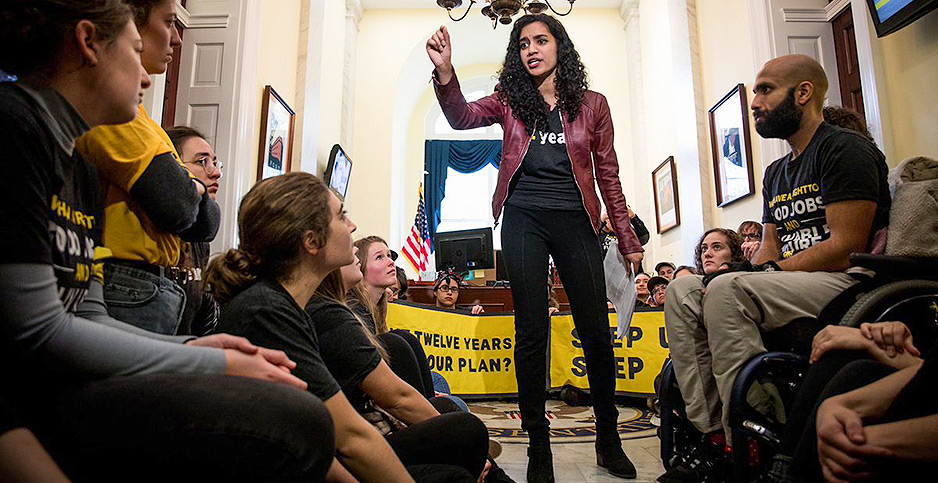
From the amazing Parkland High School students leading a national movement against gun violence after the mass shooting at their school, to the Brooklyn students from the Secondary School of Journalism walking out in protest against Summit online learning and writing a letter to Mark Zuckerberg, asking him to stop stealing their personal data, to the Sunrise Movement – an organization seemingly appearing out of nowhere and achieving prominence in the halls of Congress and Capitol Hill, advocating for an ambitious “Green New Deal” to stem climate change, these young activists have shown the rest of us the changes that must be made.
The best speech: Finally, I wanted to share with you what I think was the most eloquent address of the year, made by 15 year old Greta Thunberg, a Swedish climate activist who also happens to be on the autism spectrum. At the UN climate conference last month in Poland, she exhorted world leaders to take action before we run out of time to prevent the most catastrophic effects of global warming. Greta’s own protests outside the Swedish Parliament each Friday have inspired student walk-outs throughout the world.
Thanks to Amy Goodman of Democracy Now for broadcasting Greta’s speech – and for an interview with Greta and her father, Svante Thunberg, who are coincidentally descendants of Svante Arrhenius, the first scientist to estimate how increases in atmospheric carbon dioxide would increase global temperatures, more than a century ago. Take a look.