Showing posts with label school governance. Show all posts

Sunday, March 6, 2022

Why Friday's hearings on Mayoral control were the best in twenty years -- and what was said about the need for smaller classes & more fiscal oversight


I’ve testified at countless mayoral control hearings since it was instituted nearly 20 years ago. Yesterday’s joint Senate and Assembly hearings far surpassed any of them.  You can watch the video here. Sorry to say there were very few news stories about it, because most of the education reporters were covering the Mayor's announcement about lifting the mask mandate in schools.  It was their loss, since the questioning by legislators was sharp and had a new seriousness about it, and the testimony from parent leaders was passionate and incisive.

In recent years, the opposition to Mayoral control has grown, here in the city and nationwide.  As I point out in my testimony, the system has never been popular among average voters.  But the evident dysfunctionality of the system and the way it allows autocracy to override the wishes of parents and the needs of children, no matter who is Mayor, is now more widely recognized.  Many districts such as Detroit and Newark that once suffered under mayoral control or worse, state control, have returned to an elected school, and Chicago will soon do so.  

This was the first time in my experience that influential legislators seem really intent about making improvements to the law.  Sen. John Liu, chair of the NYC Education Senate committee, and Sen. Shelley Mayer, chair of the NY State Senate Education Committee, along with Assemblymembers Harvey Epstein and Jo Anne Simon, closely questioned Chancellor Banks  about what changes could be made that would ensure that parents have a real voice in the system.  Yet he seemed strangely unprepared for their pointed questions.


After a brief appearance by Mayor Adams, who was driving in his car but didn't have time to answer any questions, Chancellor Banks said that the DOE had brought down school Covid positivity rates  from
16% at the beginning of January, to below 1% now, which he claimed was a "direct result of Mayoral Accountability."  

Yet as was widely reported, Omicron exploded in our schools with tens of thousands of students becoming infected in January, with DOE's safety protocols recognized to be  largely ineffective.  The Omicron surge rose and fell on its own in our schools, as it did nearly everywhere else in the city and indeed the nation, and this had nothing to do with any new measures put in place by the Adams administration. Indeed, as I pointed out in a tweet, the schools in Los Angeles have put in place far more effective Covid vaccine and testing protocols, and their schools are governed by an elected school board.

Banks also claimed he would be a far different kind of Chancellor than those who preceded him, because he himself had gone through the public school system.  Unmentioned was that Joel Klein attended NYC public schools as well, and we know how little respect he showed parent and community views and priorities.

Banks promised that he intended to closely collaborate with the parent-led Community Education Councils.  But when AM Epstein asked him what he thought of any of the numerous specific improvements to the Mayoral control that the CECs have proposed in many resolutions, Banks admitted he hadn’t read them.

Senator Shelley Mayer followed up by asking whether he would agree to any specific changes to the law to ensure parent input is taken seriously.  Banks then turned to Deputy Chancellor Weisberg to ask "Dan do we agree with any changes?" Weisberg, who was himself high in the DOE leadership structure for six years under Chancellor Klein, said no.

There was also much discussion on the failure of the DOE to put any effort into reducing class size during the twenty years of mayoral control -- even though this is a critical reform proven to help students learn, especially students of color.  Smaller classes are also the top priority of NYC K12 parents every year on the DOE's own parent surveys.


The topic of class size was first introduced  by Sen. Robert Jackson, the original plaintiff in the Campaign for Fiscal Equity lawsuit, which after many years of advocacy, is finally bringing more than $1.3 billion in additional state funds to NYC schools. Yet the administration plans to invest none of these funds in lowering class size, though the city's excessive class sizes were a central issue in the lawsuit and the court's decision that our students were deprived of their right to a sound, basic education.  The topic of class size was also mentioned by AM Jo Anne Simon and some other legislators. 

Sen. Jackson repeatedly threatened that he would hold back state funding if the DOE refuses to lower class size, as outlined in the his bill S6296A, and the same as Assembly bill, A7447A, sponsored by AM Simon. Jackson also implied that his support for continuing mayoral control was at risk due to DOE negligence on the issue-- and that in any case, he would not support an extension of more than two years.

When asked what were their plans in terms of class size, Banks again deferred to Weisberg, who said that class sizes had already decreased this year, partly because of enrollment decline - which is true. Though I hadn’t commented on the issue in my written testimony, when I had a chance to testify in the afternoon, I pointed out that if the city's proposed budget cuts to schools are adopted, amounting to nearly one billion dollars over three years, class sizes will quickly increase to their former levels. 


In response to Jackson's questions, both UFT President Michael Mulgrew and CSA President Mark Cannizzaro agreed that lowering class size was critical; Cannizzaro added that to do so, the Fair Student Formula (FSF) that  is the main source of every school's funding must be altered, since it  is aligned to large classes. 

In my oral testimony, I pointed out how the FSF Task Force created by the City Council in 2018 had never released their report, because its members pushed for revising the formula to allow for smaller classes, but the Mayor's office under de Blasio had stifled their concerns, by refusing to allow the issue to be mentioned in the report.

Another problem that both Mayor Adams and Chancellor Banks encountered is a glaring contradiction in their rhetoric .  Both repeated their now-familiar refrain about how terrible our schools are, especially for Black and brown kids. But of course, if true, this failure persists after twenty years of mayoral control - the very system that they claim is necessary to solve the problem. 

Banks tried to get around this evident contradiction, by testifying that all the deficiencies exhibited by our schools are the result of the system that earlier prevailed, more than twenty years ago: "We are still dealing with the remnants of the past world before Mayoral Accountability was adopted.  Corruption, patronage, and inequity ruled the day, and our students suffered greatly.  That is evident in some of the glaring disparate outcomes we still see, especially for communities of color."

Yet this argument didn't seem to be particularly convincing to the legislators.  In fact, in the first five hours or so of the hearings, while I was still watching, only one of them expressed strong support for continuing the current system for another four years, Senator Luis Sepulveda from the Bronx.  A four year extension is what Gov. Hochul has proposed and of course Adams and Banks would prefer:  The attitude of the other legislators seemed to range from slight skepticism to clear opposition,  at least during the portion of the hearings that I was able to observe.


Moreover, the parent leaders who spoke were nearly unanimous in their criticism of the way in which mayoral control had allowed their voices to be ignored and the needs of their community's public schools to be trampled upon, by both Bloomberg and de Blasio.  Their testimonies were tremendously compelling,  and in their combined impact, overwhelming.  I hope you watch them here. There was only one parent among the scores who spoke during the first five hours who said she supported the current system to any degree: Yiatin Chu, the co-chair of PLACE,  and even her co-chair, Lucas Liu, appeared to disagree. 

My brief oral comments are at about 4 hours and 46 minutes into the video, and focused on two issues: class size and fiscal accountability.  In my written testimony, I detailed and supported many of the changes proposed by the Education Council Consortium and the CECs, including a reconfiguration of the Panel for Education Policy so that the mayor no longer appoints a majority of members, and a requirement that the DOE should be made subject to local laws passed by the City Council.  Currently, unlike every other city agency, the City Council can pass laws regarding education only in the area of requiring more DOE reporting, not in any policy area.  I also spoke about the need for stronger fiscal oversight by the   Panel for Education Policy, who every month routinely rubber stamp many wasteful contracts worth hundreds of millions of dollars, with insufficient scrutiny and sometimes even those awarded to vendors who had previously been shown to be corrupt. 

To address these glaring problems, I proposed that the NYC Comptroller be able to appoint a non-voting PEP member, who could provide expert counsel on contracting and other financial matters .  I also proposed that the Comptroller be responsible for training the PEP members in financial oversight, accountability, and fiduciary responsibilities.  According to state law, all Board of Education members are supposed to receive at least six hours of such training; and yet PEP members have publicly said that the training they receive is insufficient and minimal at best.

The state law does include a provision that the DOE is exempt from these requirements, but only if the Chancellor certifies annually in writing to the State Education Department that the training that PEP members receive is at least as rigorous as the law requires.  Yet after I FOILed the State for these written certifications, NYSED said they hadn't received any in at least the last three years. 


Friday, March 4, 2022

Why Mayoral control must be amended ; testimony for today

Joint State Legislative hearings are being held today starting at 10 AM; you can watch them here.  I'm slated to speak around 2:30 PM.  Though we've opposed the current governance system because one-man rule does not work, is inherently undemocratic and leads to dysfunctional decision-making, opposition to Mayoral control has grown in NYC and nationwide in the last few years.  

Several districts that once had Mayoral or state control have returned to an elected school board, as I point out in my testimony below. 

Sunday, February 3, 2013

Two new proposals to revamp mayoral control; about time!

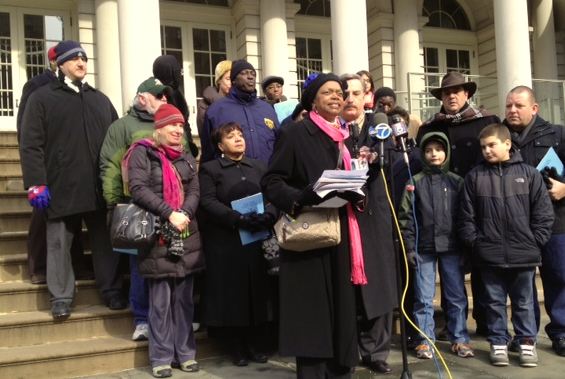
State Sen. Velmanette Montgomery on  steps of City Hall today
State Senator Velmanette Montgomery of Brooklyn and Assemblymember David Weprin of Queens announced today they would introduce a new bill that would end mayoral control, by taking away his supermajority on the Board of Education, now called the Panel for Educational Policy.

The Board (or Panel) would continue to have 13 members:  five appointed by the borough presidents, all public school parents, as now; and four appointed by the mayor, one a public school parent.  Four members would also be appointed by the City Council: One a representative of a college or university; one a member of a parent's organization; one a member of a Parent's Educational Council [CEC?]; and one at large. 
The Chancellor would be appointed by the Board rather than the mayor.  
Expect howls of protest by the tabloids tomorrow, saying this is a teacher union plot but nothing could be further from the truth.  The outrage and frustration among parents has never been more intense, resulting from the mayor's brutal steamrolling of his policies, sticking it in our faces , and continually implementing policies that damage our kids and our schools.   As Mike Reilly of CEC 31 put it today, "Instead of parental engagement we have parental estrangement."
Just two examples:  every year parents say their top priority on the DOE's own survey is smaller classes;  yet every year class size increases, and the mayor has the nerve to say he would double class sizes if he could.  Meanwhile, corrupt multi-million dollar contracts are renewed and rubber-stamped by the PEP for companies that are either under investigation for having stolen from DOE  or have been proven already to have overcharged DOE in the past. The latest outrage is Bloomberg's rejection of the teacher evaluation deal which will cost our schools $250 million, because he wouldn't allow for a two year sunset. 
Speaking eloquently and passionately in support of the bill were Mona Davids of the NYC Parents Union, CMs Robert Jackson and Jumaane Williams, Santos Crespo head of Local 372/DC 37, Carmen Alvarez and Emil  Pietromonaco of the UFT, and Sam Pirozzolo, President of the Community Education Council 31 in Staten Island. The consensus among the legislators, parents and union officials is that we cannot wait until mayoral control sunsets in 2015; the devastation to our children and our schools is too great; and we need to make this an issue in the upcoming mayoral election as well.
Meanwhile, last week, City Comptroller John Liu, a mayoral candidate, came up with a different proposal to reform the PEP.  According to his proposal, a nominating committee made of stakeholder groups will select two or three candidates for each seat on the PEP  after going through a transparent public process.  The mayor would then appoint from the list of candidates chosen by the committee.  The members would serve fixed and staggered four year terms, and once appointed, they could not be removed without due cause, rather than fired by the mayor at will any time he or she pleases, as Bloomberg has done in he past.  The PEP members would have staff support and compensation as well, allowing the entire operation to be more professionally run.  And though the Mayor would continue to appoint the Chancellor, the Chancellor would have to be an educator and the PEP would have to approve his or her selection.
I think that most parents would agree that either of these proposals, though not a complete fix of the governance problem, would be a significant improvement over the absurdly dictatorial system we have now.  On our NYC education list serv, Patrick Sullivan, the Manhattan member of the PEP (whom at the press conference today Robert Jackson called the "ideal member" for his independence and sharp questioning of DOE officials) wrote  that "best and most appropriate choice" would be  an elected board." And:
I don't see any justification for denying urban parents this avenue of participation while allowing it for everyone else. Are we somehow less competent to oversee educational policy and budgets?  Short of that Liu's proposal for fixed terms is good.

I don't see a lot of benefit to switching around which electeds make appointments.  I've been fortunate to have been appointed by Scott Stringer but I think many electeds would be swayed by influence of big money especially those interests who don't send their own children to public school but have a lot to say about how our children are educated.
It is true that many of the other borough appointees have been constrained in voting their conscience, and have gone along with the mayoral majority because their patrons, the borough presidents, have too often been manipulated and controlled by Bloomberg's power and money; except that is, Manhattan Borough President Stringer and the Bronx BP Ruben Diaz Jr.  Yet while an elected school board for NYC would be ideal, it seems very far off and too often, elections are themselves often "swayed by the influence of big money."
Anyway, I think it is our job as parents to support any and all efforts to limit the destructive one-man rule , and demand that the mayoral candidates let us know what their positions are on this issue and whether they would support more checks and balances in the system.  What do you think?  Please leave your comments below.

Thursday, July 30, 2009

Quinnipiac shiftily changes questions on mayoral control ---- yet again.


The latest Q poll appears to find that voters overwhelmingly approve mayoral control. Here’s an excerpt from today’s NY Post:

“City voters support continuing mayoral control of education by a 2-to-1 margin -- an all-time high, according to a poll released yesterday.”

Here’s an excerpt from the latest Quinnipiac press release:

New York City voters approve 57 - 30 percent of Mayor Michael Bloomberg's handling of public schools and say 56 - 24 percent that the Mayor's takeover of the schools has been a success. These are Bloomberg's highest scores on both questions.

…."The biggest opponents of mayoral control of the schools are state senators from Manhattan and Brooklyn, but two-thirds of Manhattan voters and more than 50 percent of Brooklyn voters say let the Mayor do it," Carroll said.

But actually the difference is insignificant between this month’s and last month’s results, with a margin of error of plus or minus 2.6 or 2.7 percentage points.

                     Jul 29   Jun 17  
                     2009    2009     


Continue 57 56
Stop                 30      32      
DK/NA             12      12      

Moreover, Quinnipiac has altered the questions asked on school governance so many times that it is impossible to judge whether there is any trend towards mayoral control at all.

In fact, whenever voters have been given the chance to opt for a third choice -- that the mayor could share power -- they have resoundingly come out in favor.

For example, the July 2007 and July 2008 Q polls asked voters if the next mayor should retain complete control of the public schools, share control with an independent school board, or give up control. Both years, a solid majority of voters said that the next Mayor should share power with an independent board:

                           Jul 16   Jul 26
                            2008    2007
 
Retain control          29      28
Share control           55      51
Give up control          8       9
DK/NA                        7     11

In July 2007 the headline was: “New York City Voters Tell Quinnipiac University Poll; Most Say Bring Back Board Of Education.”

Then, incomprehensibly, Quinnipiac dropped that choice, even though a majority of voters had consistently supported it.

Instead, in the January 2009 and February 2009 polls, they gave respondents only the choice of whether the Mayor should retain control or give it up. (Give it up to what? They didn’t say.) The results were predictable: voters understandably favored retaining mayoral control over an unnamed and undefined alternative.

Without alerting the press that they had eliminated the voters’ favorite option they reported their findings this way in the January press release: “Mayoral control of the public schools should continue, voters say 56 - 34 percent. Voters with children in public schools support mayoral control 57 - 39 percent. “

Later, when asked why respondents no longer were offered the option of the Mayor sharing control with an independent board, Maurice Carroll of Quinnipiac explained to the NY Times that they had decided that “independent” was too positive a word. Hmm.

Then, in March 2009 and June 2009 the next set of Quinnipiac polls offered respondents new choices – not the excessively “positive” one of the Mayor sharing power with an independent board, but instead the possibility of sharing control with the City Council and/or the Borough Presidents. Both times, most voters again favored these power-sharing arrangements.

TREND: Do you think the mayor should share control of the public schools with the city council or not?

                     Jun 17 Mar 24
                     2009    2009
 
Yes                 52      53
No                   37      37
DK/NA       11   11
 

TREND: Do you think the mayor should share control of the public schools with the borough presidents or not?

                     Jun 17 Mar 24
Yes                   49      50
No                     41      41
DK/NA              10         8

Then inexplicably, in the latest poll, the Q pollsters again dropped these questions, but merely asked whether the mayor should retain power, or give it up to an undefined authority – knowing full well that every time in the past they offered voters the chance to choose power-sharing, they approved.

Indeed, see this May 2009 Marist poll, in which voters were asked if “the responsibility for running the city's public schools should remain under Mayor Bloomberg or should responsibility be given to an appointed citywide Panel on Education Policy?” 60 percent of voters preferred that the authority be given to an appointed citywide Panel compared to 32% for continued mayoral control.

As most pollsters know, the results you get depend on what questions you choose to ask, and how.

Saturday, February 7, 2009

Diane Ravitch speaks the truth on Mayoral control

See video below of Diane Ravitch's impressive testimony on Mayoral control, and questions from the State Assembly members. In response to a question from chair of the Education committee, Cathy Nolan, she also has some choice words to say about the reliability of the State Education Department.

Excerpt: "Never before in the history of NYC have the mayor and the chancellor exercised total, unlimited, unrestricted power over the daily life of the schools. No other school district in the United States is operated in this authoritarian fashion.

We have often been told by city officials that the results justify continuation of this authoritarian control. They say that test scores have dramatically improved. But no independent source verifies these assertions...

[The Chancellor who is ] the leader of the school system should be appointed by the independent board, not by the mayor. The chancellor’s primary obligation is to protect the best interests of the students. If elected officials say that they must cut the schools’ budget, the chancellor should be the voice of the school system, fighting for the interests of the children and the schools. If the chancellor is appointed by the mayor, his first obligation is to the mayor, not the children.

thanks to David Bellel for the video.

For news clips on the Assembly hearings yesterday, see Klein Defends Mayoral Control of Public Schools (NY Times) , Joel Klein under fire admits bus bungle (Daily News), 200 Pack Hearing on Mayoral Control of Schools (WNYC), Debate Over Schools Control Heats Up At Hearing (NY1) and several entries at Gotham Schools.

Tuesday, February 3, 2009

Debate on Mayoral control; check it out!

Check out the first hour of the Feb. 2 forum on Mayoral control, sponsored by the Queens Civic Congress.

Participants included Dina Paul Parks, Senior Policy Advisor to Deputy Mayor Walcott; Phyliss Bullion, Council of Supervisors & Administrators; Carmen Alvarez, VP of the UFT; April Humphrey, Campaign for Better Schools; and Rob Caloras, President, District 26 Community Education Council, and me, Leonie Haimson of Class Size Matters. The debate was moderated by Elizabeth Green of Gotham Schools.

Towards the end of the clip, there's a real disagreement about whether the Chancellor has changed the principal selection process; thankfully Carmen Alvarez was there to back me up that power has indeed been taken out of the hands of school leadership teams!

Dina Paul Parks also insisted that there is genuine CEC and district input into the decision to close and open new schools -- please let us know in the comment section if you think this is the case, or not.

Carmen also describes some of the UFT's recommendations that had been released that day; for the entire report, check it out in pdf. News accounts of the UFT's proposals were published today in the GothamSchools, NY Times, and the Daily News.


Learn NY - and the future of our schools

Many parents have been asking us about Learn NY -- after having been contacted by this organization.

Learn NY is an organization established by allies of Mayor Bloomberg to retain his choke hold on our schools after the current governance system sunsets in June 2009.


The organization’s paid representatives, including Peter Hatch, Robin Warren, Brian Keeler, and Julie Wood, all claim that their activities are not funded directly by Bloomberg, but so far have refused to divulge who is paying their salaries. They admit to having raised millions of dollars, and have hired several prominent and well-connected lobbying and consulting firms to push their agenda with the Legislature in Albany.


The problem is that there are few if any involved public school parents who trust this administration’s good intentions, after having witnessed six years of unilateral, strong-arm tactics, in which the Mayor and Chancellor have ignored their views, and have imposed misguided policies on our children’s schools. So Learn NY is hard at work, trying to recruit parents and make them believe that they are actually interested in what parents think.


On the Learn NY website, they may say they have “made open dialogue with parents a priority”, but they have turned down several offers to meet with established NYC parent groups, and have so far refused to speak at any public forum that includes representatives from groups with opposing views. They also claim to want to increase parent input and transparency in the current governance system, but have not made any substantive proposals on how this would be achieved, except to suggest that there should be more public hearings.


Over the last six years, there have been numerous public hearings held by the Chancellor and/or other Department of Education representatives, but always after they have already decided what their policies would be. Never has this administration’s decisions been affected by a single comment, suggestion or proposal put forward by any parent or parent group. More public hearings without an administration that actually has to listen to the views of parents and take them into account before making decisions would be useless.


The position of Learn NY on the need to improve transparency also seems to be hypocritical, since they refuse to be transparent about who is funding their own operations, and their tactics are anything but transparent. An anonymous person left pro-Mayoral control comments on several blogs, until he was eventually unmasked as Brian Keeler of Learn NY. Moreover, their website includes much distorted data and PR spin, rather than actual fact.


Instead of Mayoral dictatorship, we need a system in which the Mayor would have to forge a real partnership with parents. Instead of PR spin, we need the truth. For more information about our concerns, please visit the NYC public school parent blog. Send us a message at NYCPublicSchoolParents@gmail.com.

And please, testify at the hearings on Mayoral control to share your views; the schedule is here.

Weiner doesn't have a problem with Mayoral control, just the Mayor

Check out Elizabeth Green’s description in Gotham Schools of the two unexpected visitors to our panel discussion on school governance last night in Queens -- Council member Bill de Blasio, running for Public Advocate, and Congressman Anthony Weiner, a candidate for Mayor.

As opposed to de Blasio, Weiner said last night that he’s not against changing Mayoral control, just changing the Mayor. He didn’t seem to have listened to what anyone on the panel had said about the numerous problems with the current governance system: Weiner doesn’t have a question; de Blasio on mayoral autocracy

Monday, September 22, 2008

History of NYC governance and lessons for Mayoral control

Check out the first public session sponsored by the Parent Commission on School Governance and Mayoral control, about the history of NYC governance in our schools, held on September 17 at Murry Bergtraum High School.

On the panel was Diane Ravitch, eminent historian and critic, Jitu Weusi, former teacher and one of the organizers of the Ocean Hill-Brownsville events, Betty Rosa, former principal and superintendent of District 8 in the Bronx and now a Regent. The session was moderated by Pedro Noguera of NYU.


The introductions are a little lengthy (my fault!) but start watching at about ten minutes in and the rest is dynamite.

What's amazing is that these panelists, coming from very different backgrounds and with quite different political views, should agree so profoundly that the current governance system puts too much power into the control of two men, neither of them educators, lacks transparency and accountability, and should be significantly reformed by the Legislature when Mayoral control sunsets next spring.

Monday, September 8, 2008

First public education session sponsored by the Parent Commission on School Governance

The History of NYC Public School Governance

When: Wed. Sept. 17th at 7:30 PM.

Where:
Murry Bergtraum HS, 411 Pearl St., Manhattan, behind City Hall.

Speakers include:

  • Diane Ravitch, eminent educational historian;
  • Jitu Weusi, veteran educator, community organizer, and one of the organizers of Ocean Hill-Brownsville;
  • Betty Rosa, former Principal and Senior Superintendent, District 8, elected as a Regent from the Bronx in 2008;
  • Moderated by Pedro Noguera, NYU Professor.

Please spread the word! A flyer (in pdf) you can distribute or post in your school is posted here or just click on the picture to the right.

For more information, please email parentcommission@gmail.com