Thursday, February 16, 2012

My take on the teacher evaluation deal announced today in Albany: disappointing & with uncertain results

From what I can tell, the part of the deal that was struck between the city and the UFT seems to be a good one: an external arbiter for the subjective teacher ratings by principals, which is necessary considering the number of unfair "U" ratings we have seen from abusive principals in recent years.  CORRECTION: I should never comment before reading the reporting and the fine print.  Apparently, only 13% of teachers will have independent review the 1st year of  an "ineffective" rating from a principal, and none the second year, according to GothamSchools.

The rest of the deal statewide is very disappointing.  If I am reading the agreement correctly, it founders on four main points:
 .          Teachers will be rated on a curve, with the commissioner having the ultimate power to decide whether the curve is "rigorous" enough -- meaning automatically some teachers must fail;
.         Any teacher rated 0-64 out of 100 will be rated "ineffective" (which seems to be a biased scale);
.         If a teacher is rated ineffective thru growth rates on assessments alone, he or she must be rated ineffective overall; making the agreement to base 20-40% on test scores a total fiction.  If the 40% turns out to be state test scores alone, no matter how used, the results will be unreliable and erratic, teachers will be unfairly evaluated and  students will suffer as a result.
.    The agreement also gives the SED Commissioner too much power -- the authority to approve or disapprove any local evaluation plan he deems "insufficient."
Since the state agreement will govern NYC as well, what it means for our schools will depend on what our local assessments turn out to be. 
If they turn out to be yet more standardized tests, like the 408 standardized exams the city bid out this summer, this will mean our schools become even more test prep factories, with teachers unfairly rated and less learning in the classroom.   
Thus it is critical that some form of portfolio work, based on actual classroom work, be used for the 20 percent local assessments. But will the DOE agree to this? Will the Commissioner agree to a portfolio system, especially as he seems to believe test scores should trump all? Who knows.
As made clear at the press conference, the city has also not yet agreed to refrain from closing the 33 SIG schools -- despite this deal.  There are still many unresolved issues on the table.
In the end, this new statewide evaluation system represents a vast experiment on our kids,  with uncertain and potentially damaging results.  And all this, to get Race to the Top and SIG funds -- most of which will spent on consultants, more testing and data systems -- not to benefit the children.

Panel discussion Saturday: Parents As Educators & Putting the Public Back into Public Education

I will be speaking on a panel Saturday morning, sponsored by Assemblymember Keith Wright and organized by the Urban League, as part of the Black and Puerto Rican caucus meeting in Albany

The details are below.

10:15 AM - 11:45 AM

MEETING ROOM 6 (on the concourse, near the convention center)
 

WORKSHOP TITLE: Parents As Educators: Putting Public Back into Public Education

SPONSOR: Assemblyman Keith Wright


DESCRIPTION: Workshop will include community and school based strategies and models on how to increase parent engagement in the education and advocacy of their children. Advocates will provide information and analysis of existing educational policy on parent engagement. Attendees will receive a free copy of the New York Urban League's "A Parent's Guide to College."


Panelists include Danielle Moss-Lee, Director of Harlem Educational Activities Fund (HEAF); Leonie Haimson, Executive Director of Class Size Matters; Ocynthia Williams, Coalition for Educational Justice; Anthony Harmon, Dir. of Parent and Community Outreach, United Federation of Teachers; Mark Winston Griffith, Executive Director of Brooklyn Movement Center.

Arva R. Rice, President & CEO of the NY Urban League, will serve as the moderator.

Wednesday, February 15, 2012

Noah Gotbaum of CEC 3 and Lisa Fleisher of the WSJ on the unreliable teacher data reports

From this morning's Good Day New York. 


Why the release of the Teacher data reports and adoption of a new statewide evaluation system will be bad for teachers and bad for kids

UPDATE: please sign our petition, also to the right , urging the newspapers not to publish this unreliable data.  

The UFT has lost its lawsuit and the DOE says it will release the teacher data reports to the media within weeks, with all the major newspapers expected to print them.  These reports, which rate 12,700 NYC teachers by means of  numerical ratings of 1 to 100, are based solely on the 2010 test scores of their students, filtered through a complicated value-added formula.  They are widely seen by many experts as highly unreliable, based on false or incomplete data and with huge margins of error -- even if you believe that standardized test scores alone are all that matter.

The city will release these data reports, despite the promise in 2008 by then-Deputy Chancellor Chris Cerf, now Acting NJ Commissioner of Education,  that the DOE would do everything in its power to keep them confidential.

Even the expert panel that DOE claimed supported their methodology pointed out that these figures cannot  be trusted.  The DOE had posted this statement in 2008, which is still online,  in defense of the Teacher Data reports:

“A panel of technical experts has approved the DOE’s value-added methodology. The DOE’s model has met recognized standards for demonstrating validity and reliability.”
Yet the opposite was true, as revealed by a document that I finally received in 2010, more than a year after I had FOILed it.  (See also this Juan Gonzalez column for more about this document and my FOIL.)  

Here are just a few of the comments from this panel of "technical experts" handpicked by Tweed, who refused to endorse the method's use "for accountability, promotion or tenure" purposes:

1) Test scores capture only one dimension of teacher effectiveness, and they are not intended to serve as a summary measure of teacher performance…

2) If high stakes are attached, there will be potential to game these measures by teaching to the test, selecting students, altering difficult-to-audit student characteristics, or outright cheating. …
3) To calculate expected test scores…there are likely to be additional factors not yet considered that influence student achievement. etc. "
I can think of no other profession in the public or private sector in which this kind of unreliable and potentially damaging data is made public.  The only effect of this will be to further undermine teacher morale -- already at an all-time low in this city -- and to dissuade teachers from working in our public schools and with the highest needs children.  Yet so far, GothamSchools is the only media outlet that has pledged not to publish them

Meanwhile, the Governor is pushing a deadline of Thursday for the state and city teacher unions to agree on a statewide evaluation system, called APPR,  for the Annual Professional Performance Review, that will rate teachers 20-40% on test scores, and the rest on principal evaluations. Yet nearly one third of all principals in the state have signed onto a letter protesting this system, for reasons that are further explained here and here.  In the city there is even more discord, because the DOE refuses to give teachers the right to appeal a principal's negative rating to an independent arbiter, despite numerous documented cases in which NYC principals have arbitrarily delivered unsatisfactory ratings to teachers for political or personal reasons.

Below is a letter from eight esteemed Teachers of the Year, originally posted on the NY State Teachers website, sent to the NY State Board of Regents last spring, pointing out how the proposed APPR is likely to unfairly penalize many excellent professionals, especially those work with at-risk students.  Nevertheless, on Monday, the Regents voted to go full speed ahead with its NCLB waiver application to the US Department of Education, that will further commit them to this damaging evaluation system.

____
Dear Chancellor Tisch and Board of Regents,

It is with sadness, pain and frustration that we write this letter. We are deeply concerned about recent changes to the State Education Department's Annual Professional Performance Review system. These changes, while politically popular, will neither improve schools nor increase student learning; rather, they will cause tangible harm to students and teachers alike.

The changes to APPR will kill the spirit of collaboration that developed from NYSED and NYSUT working together. Evaluating teachers based on test scores is a huge paradigm shift. The fact that NYSUT was willing to work with NYSED to develop a fair evaluation process shows good will on the part of teachers across the state. To unilaterally change the terms of a jointly crafted law at the eleventh hour poisons the atmosphere. Without buy-in from practitioners in the field, this reform effort is unlikely to succeed.

We believe in appropriate use of data to improve student achievement.

Likewise, we believe that schools should develop rigorous systems to evaluate teachers and support professional growth; however, to allow 40 percent of a teacher's evaluation to hinge on a single standardized test score risks great harm to our schools and the people therein.

We could quote the research of educational experts like Diane Ravitch, Richard Rothstein and Jonathon Kozol as to why poverty and parental support affect test scores significantly more than any curricular changes a school can provide. We could refer to myriad child psychologists who have documented the deleterious effects of high-stakes testing on our nation's youth. We could call upon assessment experts who insist that standardized tests were not developed to evaluate teacher effectiveness. And we could examine the last decade of educational results that followed No Child Left Behind: rampant gaming of the system to provide the appearance of growth, narrowing of the curriculum, excessive teaching to the test and virtually no change in the achievement gap.

All of the above would lead the reasonable person to be skeptical about using standardized tests as the engine for school reform. Worse yet, we fear that the competition generated by this approach will reduce the collaboration necessary for true school improvement.

To illustrate the challenges of the new APPR system, we offer these stories from our schools:

1) Andrew has a severe learning disability. He is a hands-on learner who struggles on written exams. His resource teacher, counselor and mother thought he would be best-served taking a challenging science course, even though everyone knew he would fail the Regents exam. When 40 percent of a teacher's evaluation depends on that test score, will schools still make this sort of humane, pedagogically sound decision?

2) Jason missed two days of school this week for golf sectionals. He is a weak student and will struggle to pass the Regents exam. He will miss yet another day next week and perhaps more days if he advances to the state tournament. These golf matches were scheduled during school hours by officials representing New York State. Does the coach or sectional committee bear any responsibility for Jason's performance on the Regents exam?

3) Tranh moved to America in January to live with his uncle. He speaks very little English and missed half a year of instruction. Who is accountable for his standardized test scores?

4) Simone will miss school all next week because her parents are taking the family on vacation. She will miss five days of instruction for this illegal absence. Will her teachers get an asterisk placed next to Simone's test scores?

5) Emily finally told her doctor and her parents that she is struggling with depression. She is starting counseling and medication. Needless to say, her grades are suffering. As Emily's life hangs in the balance, how do we find the strength to show her compassion when we know her poor grades will negatively affect our evaluation?

6) Trudy is a veteran teacher. She volunteered to teach a class of at-risk learners because she has the skills to do so. Her passing rate on the Regents exam will be significantly lower than her peers teaching the stronger students. Under the new APPR, what motivation will teachers have to take on the most challenging students?

7) Marcia teaches art, Beth teaches special education and Craig is a guidance counselor. There are no standardized assessments attached to their jobs. They are gifted educators, but they - like many others in our profession - will not feel the same pressure as those teachers who have a high-stakes exam attached to their course. How do we deal with the divisiveness caused by this inequality?

8) Diane teaches fourth grade. She worked diligently to prepare her students for the ELA. She went to workshops to learn about standards and her passing rate suggests great skill as a teacher. Last spring, the cut scores were changed without warning. Suddenly both Diane and her students seem less-skilled. How do we ensure that the vagaries of testing don't harm people like Diane and her students?

All of the above issues are real and will take time to work out. That's why the new APPR system must be implemented slowly and thoughtfully. Increased time would allow schools to grapple with these thorny issues. Forcing schools to implement a plan without proper preparation will produce anger, stress and confusion, none of which will help kids.

We fully understand the desire to improve accountability. Using external assessments for a small part of a teacher's evaluation, as agreed to by NYSUT, seems fair and reasonable. Changing the law without warning seems less so.

On behalf of our colleagues across the state, we ask you to please reconsider the original plan that was agreed upon by all stakeholders.

This collaborative approach would ultimately provide the most benefit to our students.
Sincerely,
  • Jeff Peneston, 2011 New York State Teacher of the Year
  • Debra Calvino, 2010 New York State Teacher of the Year
  • Vickie Mike, 2009 New York State Teacher of the Year
  • Rich Ognibene, 2008 New York State Teacher of the Year
  • Marguerite Izzo, 2007 New York State Teacher of the Year
  • Stephen Bongiovi, 2006 New York State Teacher of the Year
  • Elizabeth Day, 2005 New York State Teacher of the Year
  • Dr. Patricia Jordan, 1993 New York State Teacher of the Year

Sunday, February 12, 2012

The state's proposed NCLB waiver responds to none of our concerns


A summary of the public comment and the response by NYSED for the state's NCLB waiver application is now posted online; presumably the application will be voted on by the Regents Monday or Tuesday.
NYSED says it received “over 50 submissions from “persons associated with Class Size Matters” and over twenty submissions from individuals associated with the principals’ letter.  The letter, signed by over one third of New York’s principals, objects to the new teacher evaluation being developed by the state.  Yet the NYSED summary responded substantively to none of our concerns, as expressed in our earlier comments.
1.  We (and many others) objected to the proposal of mandating new tests being mandated in 9th and 10th grades.  In response, the NYSED document first says (on p. 13): 
“The Department does not intend to impose new tests as a result of the waiver but will use the existing state assessment program.” 
But then on p. 19 it says “New assessments in ELA in grades 9 and 10 and new middle level assessments in science & social studies (subj. to fund availability.)”  Who knows what the reality is? These are contradictory statements. 
 
2-      2. We objected strenuously to rating teacher education programs by means of student test scores (meaning the students of the graduates of these programs) – but this document doesn’t appear to mention either our objections or this proposal anywhere.  Since the actual waiver application  isn’t included, it is hard to tell.
3.   We (and many others) objected to student test scores being used to evaluate teachers.  A good explanation of why is the oped by Long Island principal Carol Burris’ oped, one of the co-authors of the principals letter, called “Forging ahead with a nutty teacher evaluation plan.”
The response of NYSED to these vehement objections is that (p. 12) “The waiver request does not establish any new policy or requirements in terms of teacher & principal evaluation.   The waiver simply documents that actions that have been taken by the Gov. & state legislature in enacting NY’s new teacher and principal evaluation system, the Board of Regents in adopting conforming regulations, and the Dept. in implementing the provisions of regulations.” 
But the law and regulations could be reversed at any time, and really should be.  The ESEA waiver locks the state into this course, without the possibility of reversal or amendment.  Moreover, it  ignores the fact that NYSUT is in court, appealing the new state regs as violating the agreement and state law, and has won their case, at least at the first level.  It’s also interesting that as revealed in the SED summary, the School Administrators Association cites the lawsuit and asks for a delay in implementing the new evaluation system, as Delaware has apparently gotten permission for from the feds.  At the very least, the new system should piloted first and independently evaluated, before being mandated statewide.
4-We, like the principals,  objected to the cost of all these new tests and evaluations, and asked for the state to provide an estimate, like California’s estimate of  at least two billion dollars.  The state does not mention this objection; nor does it provide a cost estimate.
5. NYSED proposes raising the proficiency level for the Regents diploma to 75 in ELA and 80 in math. Of course the Regents are too easy but this should be addressed by increasing its rigor and reliability, not raising cut scores arbitrarily. And having the same standards for all students makes no sense.  On p. 20 the summary says “the Department is working w/ USDE to determine if “partial” credit can be awarded for students who score between 55 and 64….SED may seek to amend its application to incorporate this provision” but they should be asked to do this now.  Altogether the application leaves far too much up in the air and up to the Commissioner’s discretion.
6. We objected strenuously to the notion of providing cash rewards to districts that perform well according to some arbitrary formula; the NYSED summary doesn’t mention our objections to this at all.  Why is this so wrong?  First because it is a waste of money, especially when budgets are so tight, and secondly it’s not clear that the rewards won’t go to selective schools that either openly screen students before admission, or quietly by pushing them out when they are not making the grade.
The proposed criteria for such schools (listed on p. 25) would seem to make the most selective schools in the city eligible for these cash rewards, and to punish schools with significant numbers of ELL students and students with disabilities, as it says that the school will have to have made AYP w/ all subgroups.  Highly selective schools like Bard or Stuy that have practically no ELL or sped kids thus might be eligible for these  rewards.
In any case, the research overwhelmingly shows that incentive pay doesn’t work and is a waste of money.   On p. 27, the doc says that the $100,000 that each school could receive would be  “currently funded through RTTT” but what about when the Race to the Top funds run out?  Who is going to be stuck with the bill for this wasteful program then? WHY do we continue to throw money away on failed and often damaging reforms?
7.  NYSED also does not mention nor does it respond to our  most important objection: the requirement that at least 5 percent of schools be identified as “priority” schools and forced to adopt one of the four SIG intervention models – NONE of which have been proven through research and ALL of which are proving damaging to kids and communities in NYC and throughout the nation. 
None of the four models allow for class size reduction, and many of the struggling schools now slated for closure continue to have huge class sizes -- far larger than the state average and in many cases even larger than the citywide average.  This is absolutely the first step that should be taken if the SED or the DOE are serious about improving student outcomes.  Instead the SIG models mandate payments to external management companies, like the wasteful payment to New Visions, that got the contract to improve AutomotiveHS, or these schools' conversion to charter schools, or to being closed or having half their staff fired. 
How can anyone say they believe in teacher quality and then mandate that 50 percent of the teaching staff at any school be fired? 
7. It’s not clear to me from the document what graduation rates are being used for accountability purposes.  It is generally accepted that  schools with lots of high needs students should be recognized for their five & even six year grad rates– or else schools will simply push out students before their fourth year to improve their grad rates or implement substandard credit recovery programs. 
8. There are other points that I am not expert enough to opine on – like those made by the  NYS Association for Bilingual Education, recommending that the test scores of English Language Learners not be counted until they have been in this country for at least a year – and that their results be compared with other schools with large numbers of ELL students.  All this sounds very reasonable to me, lest schools with large numbers of newcomers be unfairly punished.  The response of SED to these suggestions?  
It is unlikely that USDE would accept use of a peer school methodology that incorporates demographic controls in the identification of priority or focus schools” and that “the USDE has indicated changes to those policies [for newly arrived ELLs]  will not be considered under the ESEA flexibility initiative.” 
Well, too bad then!  Either make the demand or withdraw the application!  Of course none of this would matter if the response to being identified as a focus or priority school was positive rather than punitive, in which case the ELL advocates would probably welcome this identification for the extra help it would give the schools with large numbers of newcomers. The fact that they want an escape valve reveals how negative and punitive the supposed “solutions” are recognized to be.
9.  Yet another objection goes to the heart of the accountability system:  “growth” percentiles are unreliable at best and do NOT accurately adjust to the need background of students, meaning schools and their most “at-risk” students will be punished as a result.  See this critique of growth models by  Bruce Baker of Rutgers. And the students at the identified schools, if they are face with closure or firing of half of the staff will likely NEVER be provided with an opportunity to graduate with a quality diploma–see the situation of the situation of Jamaica High School for more evidence.
Is this really what we want to do, to punish our students – particularly our highest need kids? 
All these concerns reinforce my conviction that the state's proposed waiver from NCLB is even worse than NCLB itself.

Saturday, February 11, 2012

Dmytro Fedkowskyj on why he voted "No" on the 23 school closings


Here is the statement made by Dmytro Fedkowskyj,  Queens representative on the Panel for Educational Policy, before voting against the 23 school closings and numerous co-locations.  The vote was 9-4, with the 8 mayoral appointees plus the Staten Island rep Diane Perrugia, voting lockstep in favor of each proposal by the DOE, and the borough representatives from the Bronx, Manhattan, Brooklyn and Queens voting no.  Perrugia voted with the mayor every time except for the proposal to close the one school on Staten Island, PS 14, in which case she voted no.
Students prepare and dream about their futures. Parents do what they can to help their children succeed.   
photo: Anna Gustafson
Our Principals and Teachers dedicate themselves to their school communities in order to make their student dreams come true, but all too often their pleas for support to fix, not close their schools fall on deaf ears...these proposals confuse parents and decimate school communities...and something has to change.
Some of the schools on the agenda today were schools created by this administration, which means past proposals didn't support and achieve their objectives.  The problems weren't quantified and unless a different approach is taken it will likely happen again and again...These decisions will again leave much doubt by every school community that it's the right choice.  
It’s no secret that some of our schools need more help than others, and I'm of the opinion that other measures should always be implemented before a final decision is made to close or phase-out a school.
These other measures are rarely ever implemented by the DOE because they claim these measures will take too long to obtain positive results. Well I say too bad...tackle the issues at hand and avoid the one size fits all quick fix.
Let our hardworking administrations and teachers develop their practices and initiatives so they can continue to provide a sense of consistent support and dedication to our students.   
When school grades drop from year to year, which ultimately drives the basis for these decisions, there needs to be DOE oversight and intervention at that time...not two years later when that dreadful last visit occurs by the DOE.  
The magic fix doesn't exist. It takes time and energy since our children learn at different levels. I have full faith in our principals and teachers because we have the best of the best teaching our kids and I would ask the panel not support the proposals for phase-out and give these schools the time and resources they need to be successful.
--Dmytro Fedkowskyj,  Panel for Educational Policy, Queens Representative

The Joke’s on Us

February 11, 2012 (GBN News): In a stunning development, GBN News has learned that Education Secretary Arne Duncan’s signature “Race to the Top” program was originally conceived as a practical joke on President Obama. According to a source in the Education Department, the Secretary was merely looking to embarrass the President after a particularly humiliating loss on the basketball court.

Apparently, Mr. Duncan never really expected to carry the hoax quite as far as it went. But, the source told GBN News, “Practically every state in the Union bought into it hook, line and sinker. All sorts of bizarre stuff started happening: Every teacher in a high school gets fired in order to improve it; math teachers are evaluated on students’ English scores. You couldn’t make that stuff up. But with billionaires willing to back it, it just took on a life of its own.”

“The ironic thing,” the source added, “is that the President may get the last laugh. I think Obama has been on to this all along. Why else would he sound like he doesn’t even know his own Ed Department’s policy? He’s obviously feigning ignorance just to ruin the prank and turn it back on Duncan.”

When asked if this matter is likely to sour the relationship between the two men, the source said emphatically, “No way. Come on, it’s just two basketball buddies busting each other’s chops. I’m sure there are no hard feelings. After all, it’s not like their own kids are affected.”

Friday, February 10, 2012

TV reports of Thursday night massacre: protests vs. the closing of 23 schools

None of the newspaper articles capture the full rage and bitterness expressed last night by thousands of parents, students and teachers at last night's hearings, at which the Panel for Educational Policy, controlled by the mayor, rubberstamped the closing or truncation of 23 schools.  Best among the print accounts was live-blogging by GothamSchools and the NYPost article by Yoav Gonen  (GSPost).

The videos do a far better job at conveying the atmosphere, if not the substance, of what happened last night.  Below are the reports from Channel 2 news (CBS),   Channel 7 (ABC), Channel 4 (NBC), Fox News, and a short video by Michael Galinsky, maker of the Atlantic Yards documentary, Battle for Brooklyn.

Last night was one more skirmish in the battle for our public schools, and for the future of this city. Whether it will prove to be a turning point in the history of mayoral control, brought down by the administration's arrogant disregard for the views of parents, students, and community members, remains to be seen.


View more videos at: http://nbcnewyork.com.


Thursday, February 9, 2012

Thursday night massacre

Panel for Education Policy votes to close all 23 schools despite thousands of protesters.

photo: Ben Chapman, Daily News

Mayor's poor showing in Quinnipiac poll, and vote in our poll now!

1.      A new Quinnipiac poll came out yesterday, showing that only 26% of New Yorkers approve of the way Bloomberg is handling our schools; 61% disapprove. 
57  57% think he has failed to improve our schools, and only 13% think the next mayor should retain mayoral control.  The mayor blamed his poor showing on the ads the UFT has been running and said that if he bought up enough ad time, he could reverse the results.
I have added a poll to the right hand side of our parent blog; do you think the mayor’s handling of our schools has been successful?  Do you support the school closings?  Do you think that the mayor should retain control over our schools? Please answer the questions now on the right hand side of the blog.  Also, if you have a comment leave it below.  Thanks!

Wednesday, February 8, 2012

Lawsuit filed today vs. Cobble Hill Success Academy charter school

Another lawsuit was filed today by parents against Eva Moskowitz' expanding empire of Success Academy charter schools, this time in Cobble Hill, District 15 -- where the community was not even given a chance to comment on it, since the original proposal was to place the school in D13 or D 14.

Despite the overwhelming opposition of parents, teachers and local elected officials, this highly controversial charter school was approve by the SUNY board.  News of this lawsuit was reported at GothamSchools, NY1 and S.Brooklyn Post

Below is a copy of the legal petition submitted by the non-profit, pro bono, public interest law firm Advocates for Justice, which has taken a leading role in defending the rights of parents, students, and community members who want to strengthen our public schools, rather than destroy them.  Go contribute to  them now!

A4J BrooklynSuccess3Petition Final 120208

Comments on the school closures and co-locations to be voted on tomorrow

Check out my official comments to the DOE below on the proposed school closures, co-locations and grade expansions to be voted on tomorrow at the Panel for Educational Policy.  

This includes a discussion of the effect of these proposals on the availability of CTE/vocational seats and programs, the likely impact on overcrowding and class size, and other reforms which should have been considered before closing these schools, especially class size reduction.  


Click on the charts showing  very large class sizes at some of the schools slated for closure -- including Gompers, Jane Addams, Grace Dodge, Manhattan Theater Lab -- and never given any support from DOE or a  real chance to improve before the Mayor decided to close them down.  There are more charts in the document below.


CSM Comments on School Utilization Feb. 9 PEP  

Monday, February 6, 2012

NO more school closings: IT'S TIME TO OCCUPY THE PEP!


IT'S TIME TO OCCUPY THE PEP 
THURSDAY, FEBRUARY 9TH, 5:30PM
Brooklyn Technical High School, 29 Fort Greene Pl (between Fulton and Dekalb) in Brooklyn
Near the Nevins 2/3/4/5 or the Dekalb B/D/N/Q/R 


Background
On Thursday, February 9th, the Panel for Educational Policy (PEP) will hold an open meeting and then a vote to close down dozens more schools. The PEP is an un-elected 13-member body (the majority of whom are appointed by Mayor 1% Bloomberg) whose decisions dramatically affect the lives of the 99%. Every time a vote for school closings has come before the panel, they have voted on behalf of their puppeteer, Mayor Bloomberg. No matter what impassioned students, parents, educators or elected officials have said in the past, the PEP has ALWAYS voted against the people. PEP meetings are open to the public. 

We, students, parents and educators from the 99%, invite you to join us in having our OUR OWN VOTE on the fate of our schools. 

If you don't believe Mayor 1%'s puppet board should be empowered to make decisions about our schools, come help us OPEN THE MEETING UP! In October, the panel walked out of their meeting and we held our own meeting. Click here to see how it went down. Now, let's do it with thousands!

Ways YOU can Occupy the PEP:

Option A: Are you a student, parent, educator or elected official from a school that the PEP has targeted for closure? Members of your school community should plan to use THE PEOPLE'S MIC to speak out about the mayor's policies and about your school! To see how the people's mic works, click here.

EXAMPLE: I am here because the panel shouldn't be voting without the community's consent to close down schools. In my school...

EXAMPLE: I am here because the mayor has it all wrong, and because he wants to take over space in our public schools to hand it over to charter schools. Our school is an amazing community...

EXAMPLE: I am here because what is happening here is wrong! Because the people have spoken and they say enough is enough!...

Or you can plan a song, performance, or skit. Every school that the PEP plans to vote on will have a chance to speak out and use the people's mic. Please practice! The people's mic can be tricky and you have to speak in short phrases of three to seven words and wait for people to respond. But it's a powerful tool that can change the balance of power in the room! Let's use it!

Then the PEOPLE (not the puppet panel) will vote on the state of your school!

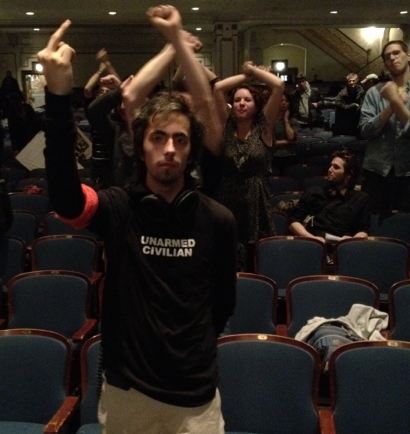
Option B: Not from a closing school? Well then we need your help to support the occupation of this undemocratic meeting! There are definitely ways you can participate. We need your voice to help amplify the voices of those speaking on behalf of their schools. We also need folks to sit near the aisle to protect the people's mic. And we're asking folks to wear shirts or stickers that identify who the occupiers are and what we stand for. For example, you might consider wearing a shirt or sticker that says "Student Against School Closings" or "Parent for Community Control of Schools", etc. There will be speeches, performances, skits, signs to hold, and more! Join us.

Please contact occupythedoe@gmail.com with any questions. Let's open up the PEP and put the decision making power where it belongs—with the people!