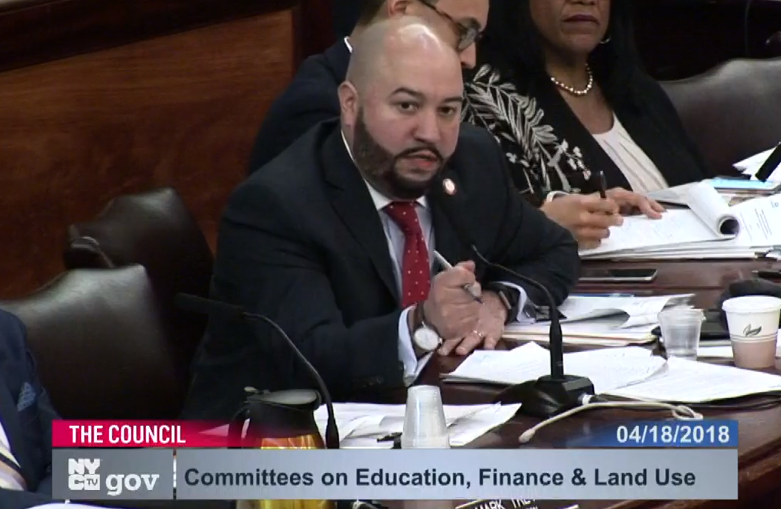
It was the first Council hearing at which Chancellor Carranza testified. Though I was disappointed that more of the questions weren't focused on the big picture of class size (how can you have equity or excellence without addressing this issue?), in response to a question from CM Treyger, Chancellor Carranza did say that he understood the importance of class size and school overcrowding in being able to deliver a quality education. He recounted that as a teacher, he knew he could do so much better for his students when he had a class of 20 to 25 instead of 45, which he had one year.
He made no promises to fully address either class size or overcrowding, however, and implied that these problems would have to wait for the state to increase its funding to the city -- which I think is a cop-out. When de Blasio wanted to expand preK, he aggressively argued for a tax increase, which then Cuomo countered by offering him the funds instead. Since his election the Mayor has never expressed the same interest in lowering class size, or indeed in any program to improve education for K12 students, either funded through a city tax surcharge or by aggressively advocating for it at the state level. Councilmember Mark Gjonaj noted the disparity in the focus of the DOE in expanding preK vs addressing overcrowding for K12 students, in particular, in making enough space to eliminate trailers.
In response to a question from CM Barron, Carranza forthrightly said he would do what he could to improve the admissions system at the specialized high schools, and to make them based upon multiple measures whether than a single standardized test. He implied he knew that the city had that authority for at least some of the schools (actually this is true of four out of the seven specialized schools ).
He ended by saying DOE should be celebrating its successful schools rather than allowing them to be denigrated, by corporate CEOs etc., and had seen some terrific teaching at Bed Stuy public schools, for example.
If so, as I tweeted below, they should be celebrating PS 25 in Bed Stuy -- which according to the DOE's own metrics, outperforms all but one charter school in the entire city, and all but three out of 633 public elementary schools, rather than shutting it down.
In short, Carranza seems to be the smartest, most progressive and articulate Chancellor in my nearly twenty years as a public school parent and advocate; as well as the most politically adept. Here are my tweets about today's hearings:
.@doechancellor talks about equity & need to put "support systems" in place to allow underserved communities to shine but isn't specific about how this will occur https://t.co/UJ0HgiBbln— leonie haimson (@leoniehaimson) May 22, 2018
No other municipality that supports its public schools like NYC - no other largeurban system investing more than here says @doechancellor - community schools etc (no mention of class size)— leonie haimson (@leoniehaimson) May 22, 2018
.@DOEChancellor repeats the old Farina emphasis on PD, but not to become "test prep" factories but broaden experience in arts etc. esp. historically underserved schools (not failing schools)— leonie haimson (@leoniehaimson) May 22, 2018
How do you assess PD asks @Dromm25 ? @DOEChancellor says needs to be job-embedded but doesn't explain. Says coaching positions are a best practice --but what are the results in districts that have literacy coaches? https://t.co/eUOEhPNjPt— leonie haimson (@leoniehaimson) May 22, 2018
Will you commit to Fair student funding to 100% by end of Mayor's term? asks @Dromm25 @DOEChancellor says depends on city & state funding. he will advocate for full funding but says city is doing this better than state. If state funds increases will address class size.— leonie haimson (@leoniehaimson) May 22, 2018
Orlando says $620M more needed for full Fair student funding to schools.— leonie haimson (@leoniehaimson) May 22, 2018
Would be good if @dromm25 or @MarkTreyger718 ask about @NYCComptroller findings that DOE is a "spending boondoggle" with 24% spent on administration rather than classrooms. https://t.co/NWJrFe1aYq cc @NYCKidsPAC— leonie haimson (@leoniehaimson) May 22, 2018
NYC also has far fewer K12 classrooms teachers than in 2007 leading to larger class sizes; large classes also contribute to classroom disruption, alienation and disengagement of students https://t.co/LkWsbcc2x9 https://t.co/TQo3O2t0gl— leonie haimson (@leoniehaimson) May 22, 2018
41 NYC schools have no full time social workers or guidance counselors which would cost only $5.2 M asks @MarkTreyger718 - will you commit to hiring them? @DOEChancellor talks about principal local control over budgets.— leonie haimson (@leoniehaimson) May 22, 2018
According to DOE’s own estimate, it would only cost $5.2 million to add at least one full-time guidance counselor or social worker to the 41 schools that currently do not have one. In a budget of $25.5 billion, $5.2 million is a drop in the bucket.— Mark Treyger (@MarkTreyger718) May 22, 2018
Lots of parents/teachers have concerns with Fair Student Funding - esp in deterring principals from hiring or keeping experienced teachers BTW. @nycmayor promised to re-evaluate this & did not follow through. cc @MarkTreyger718 @BadassTeachersA— leonie haimson (@leoniehaimson) May 22, 2018
.@DOEChancellor says there isn't too much bureaucracy; in response @barrygrodenchik. He adds @nycschools uses up to 30 reading programs; perhaps should be limited to about 5 esp those w/proven results. Also: Principals should be working w/ parents & community on how spent funds.— leonie haimson (@leoniehaimson) May 22, 2018
.@AdrienneEAdams opposes excessive school co-locations and DOE Blue Book used as a weapon vs schools esp those w/ students of color. @DOEChancellor has no answer on what training is done vs human trafficking.— leonie haimson (@leoniehaimson) May 22, 2018
Positive behavioral supports, restorative justice will create a safe & supportive environment says @DOEChancellor better than armed guards etc. as shown in Santa Fe TX - some kids may have been killed by gunfire from these 4 armed guards.— leonie haimson (@leoniehaimson) May 22, 2018
Double down on community schools in Bronx & access to nutritious school meals w/ student advisory group to make it good tasting says @DOEChancellor & Eliz Rose emphasis on environment (yet too many kids eat lunch at 10:30 AM b/c of school overcrowding)— leonie haimson (@leoniehaimson) May 22, 2018
.@DOEChancellor says re-engagement with community at Renewal schools will occur; incl w/ elected officials to learn what DOE plans are. (But will the plans improve & will they address class size?) https://t.co/CrGFiopQPY— leonie haimson (@leoniehaimson) May 22, 2018
Are you in favor of multiple criteria for admissions in specialized HS? asks CM Barron. Co-locations if temporary ok but forced co-locations whole school loses out esp w/charters; Langston Hughes promised wd have library/media rooms replaced but Hasn't happened.— leonie haimson (@leoniehaimson) May 22, 2018
.@doecarranza says multiple measures should be used in admissions to all schools incl specialized HS (when? why not do this in 5 specialized high schools where admissions under city control)— leonie haimson (@leoniehaimson) May 22, 2018
.@DOEchancellor says they are mandated to provide so-called underutilized space to charter schools which is not exactly true. (they can also give subsidy for private space.) And DOE can't build support for schools when DOE ignores communities when they say don't close them.— leonie haimson (@leoniehaimson) May 22, 2018
.@MarkGjonajNY says DOE is expanding 4K and 3K when still thousands of kids are in trailers.— leonie haimson (@leoniehaimson) May 22, 2018
.@MarkGjonajNY says no moral excuse for trailers but w/o a fully funded capital plan removal will just move & worsen school overcrowding inside.— leonie haimson (@leoniehaimson) May 22, 2018
Sadly no CMs have asked about the big picture including that school capital plan is only half funded by the DOE's admission to address school overcrowding now and in the future. @Dromm25 @MarkTreyger718— leonie haimson (@leoniehaimson) May 22, 2018
Some preK & 3K programs are being push into already overcrowded schools. True b/c of priority on preK DOE has spent lots of $ & found space for these seats quickly vs space for K12 students where more than 500K are in overcrowded schools cc @DOEChancellor @MarkGjonajNY— leonie haimson (@leoniehaimson) May 22, 2018
.@Salamancajr80 says he has bill to put Naxalone in schools; resistance from previous Chancellor, yet later teacher OD'ed in a school. What's @doechancellor position? We need all tools to save lives Carranza says.— leonie haimson (@leoniehaimson) May 22, 2018
.@BenKallos says DOE says no need for new seats but his district schools are 102% utilized. Will DOE agree to reach out to developers to include schools in projects & create incentives for new schools to be built?— leonie haimson (@leoniehaimson) May 22, 2018
SCA president says we are in constant contact w/ developers on needs for new schools. Really? If so, this not yielding meaningful results.— leonie haimson (@leoniehaimson) May 22, 2018
Strange how Cornegy talk about need to broaden admission to specialized HS beyond test scores but then promotes more test prep programs for preK to get them into gifted classes. @dromm25 questions value of tests alone.— leonie haimson (@leoniehaimson) May 22, 2018
In previous hearing Eliz Rose minimized impact of overcrowding on education; do you agree? asks @MarkTreyger718. @DOEChancellor says when he had fewer students as teacher he could do so much better, with 20-25 vs 45 students; learning environment important but funding limited— leonie haimson (@leoniehaimson) May 22, 2018
CM @MarkTreyger718 : we were told by Deputy Chancellor Rose that some of our most successful schools are overcrowded; but success for some not for all. thanks @DOEChancellor for his response that class size/overcrowding matters.— leonie haimson (@leoniehaimson) May 22, 2018
Will school safety agents be offered anti-bias training? No, this is for DOE staff only not agents which are hired by NYPD says Ramirez. Will include sexual harassment? yes says @doechancellor— leonie haimson (@leoniehaimson) May 22, 2018
.@MarkTreyger718 says can DOE help promote our pub chools? @doechancellor said we're not organized to market yet other sectors (charters?) not only market themselves but denigrate public schools. I've seen incredible teaching in schools in Bed-Stuy. we may start doing so.— leonie haimson (@leoniehaimson) May 22, 2018
One school @DOEChancellor shd celebrate is PS 25 that acc to DOE outperforms all but 3 of NYC 633 elementary schools & every charter but 1. yet rather than celebrate the school DOE is closing it. Will he reverse this decision? https://t.co/SXLvUsFzJ4— leonie haimson (@leoniehaimson) May 22, 2018