Showing posts with label class size. Show all posts

Monday, June 8, 2026

PTA President's letter about unacceptable class sizes in his child's public school & demanding a real class size plan from DOE

The DOE still has not provided any funding for schools to hire teachers for smaller classes next year.  Parents at many schools are distraught, especially as the only comments from the Mayor are his happiness that he can save over $500 million by extending the deadline for another two years -- by which time hundreds of thousands of students will be left out of the opportunities to learn in a small enough class to be able to thrive.  Here is a letter sent by Gilbert Lal, the PTA President of MS 104, about his daughter's plight. 

Dear CMs Epstein and Maloney: 

I am your constituent and my child attends MS104 Simon Baruch Middle School school in District 2 where I am the PTA president. I am very concerned that while the administration has received two more years to comply with the goals in the class size law, neither the Mayor nor the Chancellor has yet provided any information to show how they will lower class size to ensure all students receive smaller classes even within the extended timeframe.

My child’s classes this year were unacceptably large in 7th grade hitting the old cap sizes in all her classes. MS104 was able to reduce only the current 6th grade class this year and has a plan to reduce class sizes for the rest of the school in grades 7th and 8th next year.  At the beginning of the year we were extremely optimistic that the budget would be approved to allow the school to reduce class sizes next year. However, the Mayor has not approved the budget to allow the school to hire teachers to implement this program.  

My daughter  is extremely distraught that in her words "it is unfair that we fought for class size reduction and it is the law, yet I will never benefit from it. It is unfair that  [her younger siblings] got reduced class sizes at PS116 and that they will get lower class sizes in middle school in the coming years." She is right! It is unfair that I advocated for years to lower class sizes and she will not see the benefit of this. It is unfair that my other children have lower class sizes now in elementary school and will go to middle school only to have the class size almost double.  

All our children in NYC deserve lower class sizes.  We cannot delay this another 2 years. Middle School years are critical years for children as they go through so many changes. Lower class sizes will allow teachers to provide more individual attention to students and work with their needs. It is impossible in a class of 35 students to give one on one instruction. With District 2 implementing Wit & Wisdom for ELA and pressuring schools to add Geometry courses, it is even more important to lower class sizes so every child can get "What I Need". 

At the education budget hearings on Monday, please ask the Chancellor and the SCA whether they have an actual, realistic, and detailed multi-year plan to achieve the goals in the law and if so, will they provide it to you as soon as possible. I also urge you to hold off approving the education budget or the capital plan before you’re confident that such a plan exists and will be implemented.

Thanks so much,  

Gilberte Lal

PTA President, MS104

Monday, April 13, 2026

Make your voice heard on AI, the capital plan and class size!

Saturday, June 14, 2025

The NYC Mayoral debate and what the candidates said on class size

The second and final NYC Mayoral debate happened on Thursday night.  Education and more specifically class size was one of the main topics covered.  Katie Honan of the online publication The City asked each of the candidates their views on the law passed by the Legislature in 2022, requiring NYC lower class size in all grades. 

The full video of the debate is here; and the section concerning education is posted above.  I have also posted a transcript of the education section. I encourage people to watch the whole thing.

Thankfully, the only candidate on the panel to openly oppose reducing class size was Whitney Tilson, a retired hedge fund investor and charter school board member, though some candidates seemed more enthusiastic than others.  Tilson repeated a well-worn myth often put forward by those who oppose lowering class size: that the need to hire new teachers will offset any benefit that would otherwise accrue from smaller classes.   

Yet nearly every controlled study shows significant gains in student outcomes after class sizes are reduced.  One study showed that even after  Los Angeles tripled its hiring of elementary teachers following the state’s class-size reduction initiative, “the district was able to do so without experiencing a reduction in mean teacher effectiveness.” 

Moreover, even if new teachers may be less adept than veteran teachers, the research also suggests that smaller classes are likely lead to lower teacher attrition rates, which in NYC are  24% over four years.  Teacher turnover is especially problematic in our highest-need schools. This means that as class sizes are reduced in NYC, the result will likely be a far  more experienced and skilled teaching force over time.  [Interestingly, even as he supports raising the cap on charter schools, it doesn’t appear to bother Tilson that the annual attrition rate of Kipp charter schools in New York, on whose board he sits, is 23% - meaning they have to hire about one fourth of their teachers every year.)

Another issue that came up during the Mayoral debate was whether the state should provide more funding to NYC to lower class size, which both Cuomo and Lander argued would be necessary.   

My view, which I explained in detail in  testimony on Foundation Aid, is that the state should only send more funding to the city for class size reduction if and when NYC puts forward a detailed,  multi-year class size plan showing how those funds would be effectively used for this purpose.  The Department of Education has yet to propose any such plan, even though it is required by law. 

The plan should include how they will provide sufficient space for smaller classes in the nearly 500  schools that are too overcrowded at their current enrollment to lower class size to required levels. Our analysis shows that these schools currently enroll nearly half of all students.  Even then, there needs to be rigorous oversight by the state to ensure that the funds are spent appropriately towards the intended result.

Twice in the last 25 years, the state has sent millions in additional aid to the city specifically for smaller classes, and both times the city improperly used those funds to supplant their own spending on teachers. 

The first time this occurred was in 2000-2006, when the state provided more than $88 million annually as part of the Early Grade Class Size Reduction Program.  Yet two State Comptroller audits, in 2002 and 2005,  found that the extra dollars did not lead to as many new classes as they should have, because the DOE instead simply cut their own spending for teachers.

In 2007-2008, the state created the Contracts for Excellence program, and with it, provided nearly a billion additional dollars to NYC, along with a requirement that a portion be used to lower class size in all grades. Instead, class sizes increased sharply.  Another audit, this time  from the NYC Comptroller’s office, showed that these funds were again “improperly used to pay for teacher positions that would have existed without the ….program.”

In short, DOE has a terrible record when it comes to class size.  Whoever the next mayor may be, he or she cannot be trusted to do the right thing without first showing us a detailed plan for how the money would be spent.  Even then, DOE must be watched like a hawk to ensure the funds are invested to provide all NYC students with smaller classes, which is their right under the state constitution, according to New York's highest court.

Tuesday, September 17, 2024

More evidence in the just-released Mayor's Management Report that DOE has no real class size plan


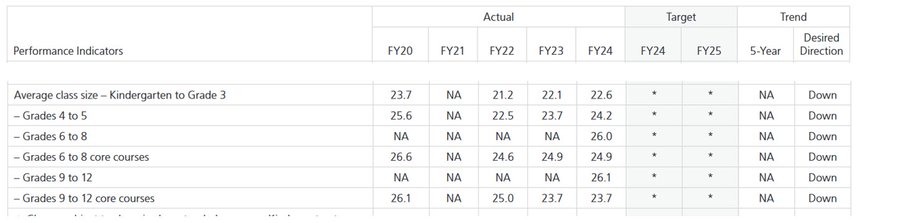
In the MMR, officials also state that they have no target figure for average class sizes, either for this year or next- which they should if they had a plan to comply with the class size law, as it requires a four-year phase-in of smaller classes in all grades.

Image

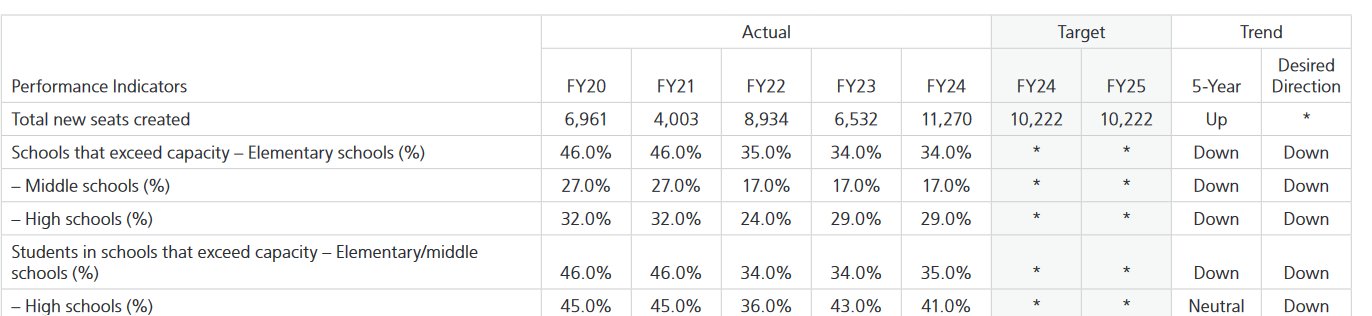
Regarding the need to create more school seats -- critical to be able to reduce overcrowding and lower class size -- the MMR says DOE "target" is to have 10,222 more school seats in FY 25.  

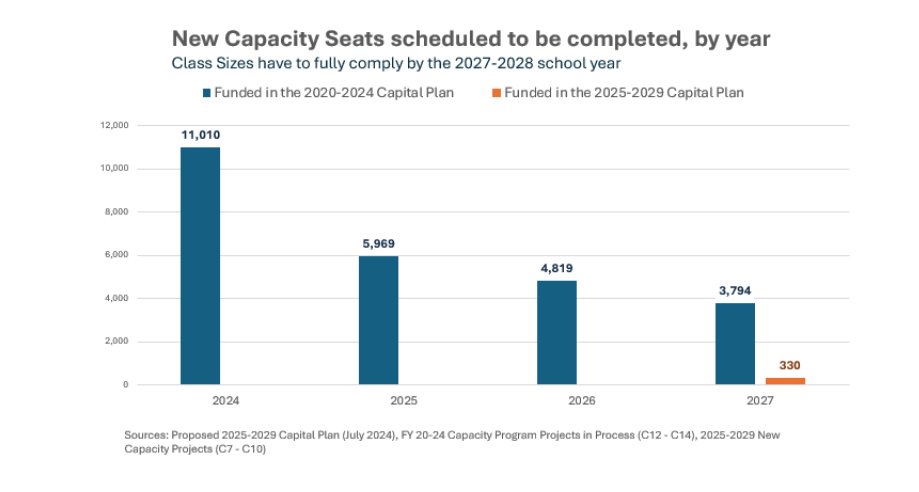
Yet the data in the capital plan reveals that the number of new seats to open next year will likely be far less – only about 6,000 - with continuing declines thereafter.  Instead of ramping up construction of new schools after the class size plan was passed, Adams cut the budget for new capacity in the capital plan by over $2 billion.  [The SCA recently added another $2 billion to new capacity in the new five-year plan, in accordance with a state budget mandate, but haven't revealed where those schools will be sited and seem in no hurry to build them.]

Image 

It  is also strange that according to the MMR, they have no "desired direction" in creating new school seats, either upwards or down.  This is especially bizarre, as there was no progress in relieving school overcrowding last year according to the report - with the percentage of overcrowded elementary, middle and high schools remaining the same, respectively at 34%, 17%, and 29%.  The percentage of elementary and middle school students enrolled in overcrowded schools actually increased to 35%.

Image

The DOE has estimated that they will need to hire 10,000 to 12,000 more K12 teachers to comply with the law within four years.  And yet the data in the MMR shows there has been a decline in the total number of teachers since FY 20 of more than 3,000.  What the decline would be if  the concurrent increase in the number of 3K and PreK teachers over that period would be is unclear, but our analysis of headcount data posted on the City Council website shows a sharp reduction in the teaching force of over over 4,000 full-time K12 teachers between FY 2019 and FY 2023.  Again, in the MMR, there is no "Desired Direction" up or down in the future for the total number of teachers on staff.


All this goes to further reaffirm our conviction that even now, more than two years after the class size law was passed, the DOE has no real class size plan - as we pointed out in a letter to the State Education Department in June 2024, urging them to require DOE to create such a plan and take affirmative, accelerated action to comply.