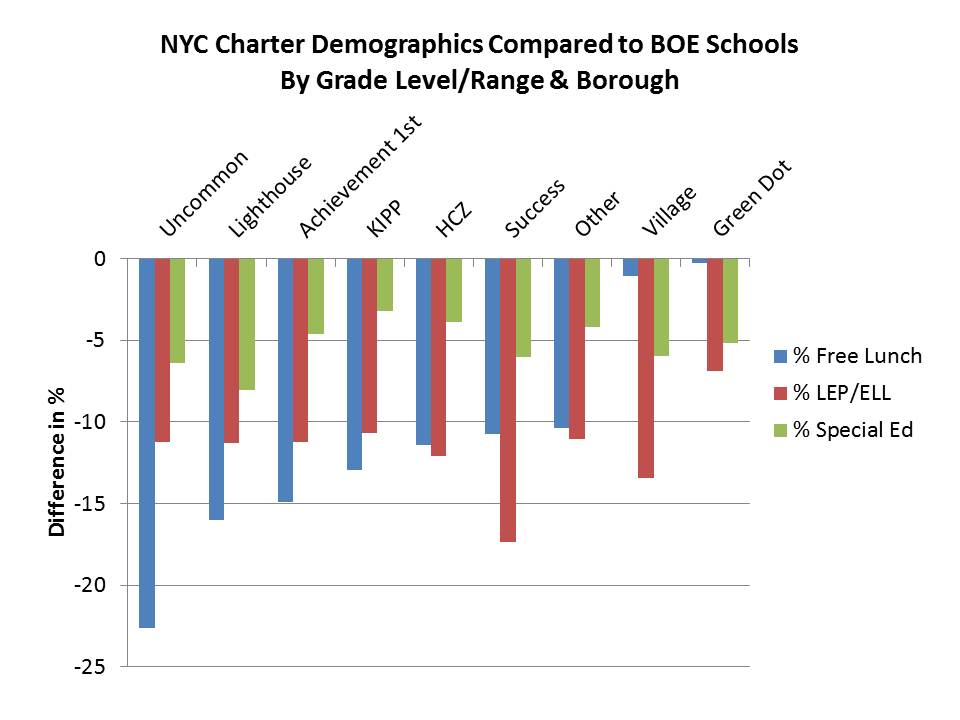
Also, NYC charters are NOT subject to fair student funding, unlike DOE public schools. Since on average charters enroll fewer English Language Learners and students with disabilities , that means they are getting more proportionally per student than most NYC public schools based on student need."The stunning sum for this coming school year will nearly double the amount the city pays for a typical charter school student's entire annual education, set by state law at $13,527, to above $24,000. The city has set aside $5.4 million a year for the next four years to pay the rent for the three schools."
Thursday, July 23, 2015
IBO analysis fails to mention important differentials in charter funding
Sunday, June 23, 2013
Crony capitalism and the inequities of NYC charter funding: Julian Robertson and the case of the billionaire scion's preschool
| (Source: GothamSchools from IBO data) |
| (Source: Bruce Baker, Rutgers Univ.) |
![]() |
| Spencer Robertson, preK and charter school operator |
Note the example of the PAVE charter school, run by Spencer Robertson, the son of billionaire Julian Robertson, a close associate of Mayor Bloomberg's.
In order to evade this prohibition, Robertson the son set up a dummy corporation for a pre-school for PAVE called the "Henry Cooper Westendarp" school, named after PAVE's director of finance. This pre-school is being funded through a separate contract with the DOE to the tune of nearly half a million dollars, and it will help ensure a steady stream of students for Spencer's charter school.
| Julian Robertson, billionaire and non-city taxpayer |
2) To increase pre-K capacity, the DoE funds a number of full and part time Universal Pre-K ("UPK") programs (usually - but not always - operated by community based organizations) throughout the City (including D15).
3) The ONLY full time D15 UPK funded by the DoE (as approved by the Panel for Educational Policy this Spring) is "pre-PAVE" which will receive slightly less than a half million dollars for 54 four year olds in full time pre-K. Coincidentally, I'm sure, this is the highest per pupil allocation of any such UPK in the entire City as approved by the PEP.
4) Notwithstanding the DoE claims that PAVE and pre-PAVE are separate entities, pre-PAVE is going to be run by Cooper Westendarp - PAVE's Chief Financial Officer (who earns over 90K per year in that capacity).
5) Furthermore, the PAVE Charter School has sought (and apparently received) approval to conduct its Kindergarten lottery seventeen months in advance.
6) As per Sonia Park, the Director of the DoE's Charter School Accountability & Support Division, those lucky winners will be "invited" (but not "required") to attend pre-PAVE this Fall. Thus, at the very least, those lottery winners will have priority over all other applicants to pre-PAVE. And if all lottery winners accept the "invitation", no other children will have access to that pre-K program.
7) In any event, according to the PAVE website, ALL pre-PAVE graduates will automatically be granted admission to PAVE. Nevertheless, at the PEP, the Chancellor incredibly denied that applying to PAVE was a pre-condition for acceptance to pre-PAVE.
9) Before the PAVE pre-K proposal was even calendared for approval by the Panel for Educational Panel, the DoE Executive Director of the Office of Early Childhood Education, Sophia Pappas, directly intervened on behalf of "PAVE pre-K" with NYC Housing Authority to personally lobby it to locate the proposed program on NYCHA property needed by Red Hood Senior Citizens.
10) While that maneuver was eventually foiled, one has to question why a high-level Educrat would be allowed to misuse her position to advance the pecuniary interests of a private party to the clearly unnecessary detriment of local NYCHA senior citizens.
11) Meanwhile, as thousands of children are being deprived access to pre-K throughout the City (30% of all applicants), the ONLY D15 public school with ANY pre-K slots available is PS 676 (Red Neighborhood School) literally located about three blocks away from PAVE.
12) This peculiar misallocation of NYC DoE resources can perhaps be explained, at least in part, by the ENORMOUS influence of the Robertson family. For example, the Chancellor serves on the Board of the NYC Charter Schools Center along with PAVE founder and Director Spencer Robertson.
13) In addition, the Chair of said Board is Phoebe Boyer, the "Executive Director of the Tiger Foundation and Interim Executive Director of the Robertson Foundation" - both of which happen to be predominantly funded by Julian Robertson (one of the wealthiest men in the world who, of course, is Spencer's dad).
Have we connected the dots yet?
Friday, September 16, 2011
We take the city to court over charter co-locations!
Yesterday morning, parent groups, including Class Size Matters, the NYC Parents Union, and individual parent plaintiffs, took the city to court over charter co-locations, and the way in which DOE provides space and service to charters for free, which we believe violates state law.
First, we had a press conference on the steps of the State Supreme Court. Then we took seats in Judge Feinman’s courtroom at 10 AM, which wasn’t nearly as crowded as when he heard the NAACP/UFT lawsuit, but was about half full with attorneys from the NYC Corporation Counsel’s office, DOE chief counsel Michael Best, and a large number of attorneys from the firms representing the charter schools. In contrast, our side was represented by one lone attorney, Arthur Schwartz of Advocates for Justice, who was terrific.
There were actually three related lawsuits that were argued by Arthur; the first was on behalf of the parents at IS 303, who oppose the proposal to co-locate Coney Island Prep charter in their building, which sparked huge protests last year. Over the last few years, IS 303 had turned around its previously struggling school, by using a program that has students stay in their classrooms rather than travel from one room to another. Arthur argued that this co-location would prevent this practice from continuing, and this would degrade the quality of education. This was backed by an expert report from the 21st Century Fund that Commissioner King had refused to consider because he received it one day after his deadline.
Arthur also cited the precedent of the CFE case, which held that NYC students had the right to a sound basic education, and said there were constitutional issues involved. He added that the Educational Impact statement for IS 303 did not properly asses the negative impact on the school’s special needs students, whose services and programs would be squeezed into inadequate spaces, though Commissioner King had claimed that DOE substantially complied with the law because the EIS simply mentioned these students in passing. Finally, Arthur pointed out that the announcement for the public hearing on the co-location was only translated into Spanish after the hearing had taken place, even though 20 percent of the IS 303 parents are Spanish-speaking.
Then Chuck Orsland, the lead attorney from the NYC Corporation Counsel’s office, spoke. When he argued that Commissioner King did not have a duty to accept the 21st Century report, Judge Feinman expressed some skepticism about why King couldn’t have easily granted an extension. Orsland also claimed that DOE had no legal requirement to notify the parents in Spanish, and that it was speculation to say that abandoning the teaching model that had improved outcomes at IS 303 would undermine the quality of education at the school.
Then Arthur went on to argue a second case: that the co-location of Explore Charter at Parkside Prep/MS 2 in Brooklyn was illegal, citing many of the same grounds. The public notification of Spanish and Haitian parents was inadequate and there was little or no analysis of the co-location’s impact on special needs students and English Language Learners. Orsland responded with a long procedural objection that I didn’t really understand about Article 78 hearings. He also argued that citing CFE was a red herring, but the Judge explained that when a co-located school takes away 40 classrooms, it may undermine the quality of education. Orsland concluded that even given these charter co-locations, the public schools remained under-utilized. (Meanwhile, the NYC Comptroller pointed out in an audit on Wednesday that the DOE utilization figures are so unreliable, with 10-25% error rates, as to be “a house of cards.”)
Finally, it was time for our case to be argued. (Here is our original legal complaint, here is our reply brief.) Arthur pointed out that NY state law holds that when districts provide space and services to charter schools, they shall do so “at cost”, but the DOE provides all this for free to co-located charters. Since co-located charters represent about 2/3 of all the charters in the city, this means that DOE forgoes about $100 million a year in revenues. This estimated figure is based on an analysis here and here, released by the Independent Budget Office in February 2011. (These analyses corrected an earlier IBO 2010 report , which mistakenly held that co-located charter schools received less in per student public funding than district public school students. Strangely, the charter school attorneys included only the uncorrected, erroneous 2010 IBO report as Exhibit 1 into evidence, without including the subsequent report or mentioning that the IBO had revised their estimates.)
Here is the relevant passage in the state law:
Article 56, Section 2853, Part 4(c): A charter school may contract with a school district or the governing body of a public college or university for the use of a school building and grounds, the operation and maintenance thereof. Any such contract shall provide such services or facilities at cost.
Arthur went on to explain that that this free provision of space and services leads to co-located charter schools being provided with more than the per pupil public funding that district public schools receive, leading to inequities in services and staffing. He also pointed out that the illegal subsidy they receive from DOE of $100 million per year could prevent the loss of many of the 2500-3000 teaching positions that have occurred, and the consequent increases in class size.
Orsland, the city’ attorney focused his rebuttal on three main points: first, there were no contracts between charters and DOE and so there was no need for these contracts to include any charges for space or services. Yet in Exhibit 2, entered into evidence by the charter school attorneys, Michael Regnier of the NYC Charter Center stated something different: that “a handful of charters may have signed use agreements…but to the best of our information and belief, those agreements were in fact never executed” (whatever that means). In any event, Orsland’s claim is contradicted by the fact that we have a copy of a signed, notarized contract between Girls Prep charter and the DOE, saying they will pay $1 dollar in rent for the space, and laying out other detailed provisions about their use. Until recently, the boilerplate contract agreement for space for co-located charters was prominently posted on the DOE website.
Orsland’s second argument was that even if the city recovered these funds, they would not necessarily be spent on new teachers or programs that benefit our children, and that instead, the DOE might spend the funds on more administrators or other priorities, so the parents’ claims of injury were hypothetical. (This point was also made in the city’s brief and the affidavit of Sharon Olds of the DOE budget office.) This led into his third point: that parents have no standing to sue and no private right of action, and whatever financial arrangement exists is instead a private matter between the DOE and the charter schools, and “we think co-location is a good thing.”
The lead attorney for the charter schools, Andrew Dunlap from Kirkland & Ellis, chimed in that if charters had to pay rent, some of them might have to close or lay off staff. These arguments were also made in the various charter affidavits, such as this one from DREAM charter director, Richard Berlin:
“DREAM currently has a model that provide for two fully certified teachers per classroom, with teaching assistants for grades K-1. DREAM would likely be forced to reduce leadership and instructional staffing, eliminating 4-6 full-time teaching position and 1 to 2 school leadership roles, destroying the DREAM teaching model parents sought to obtain by applying for a lottery pot at DREAM.”A similar affidavit was filed by Ian Newton of the Explore Empower Charter school: that his school “has a model that provide for two teachers per classroom” and if forced to pay rent, they might have to “cut core teaching positions, increasing student-teacher ratio, and destroying the Empower teaching model…”
The charter attorney, Dunlap, also argued that if these schools closed, their students would shift back to DOE schools which would lead to “worse overcrowding.” (Why? Not sure; each new school that is co-located exacerbates overcrowding, because of the need to duplicate administrative and cluster space.) He reiterated the city’s argument that the DOE might use the money for other purposes rather than hiring more teachers. The Judge interjected that perhaps the funds could be used for school supplies, since the teacher’s choice program had been eliminated this year.
Judge Feinman went on to say that “no one could argue that $100 million wouldn’t make a difference” in how the DOE provides resources to the schools, and if parents don’t have standing, who does? Dunlap maintained that parents, students, and advocacy groups had no right to sue, since none of these groups are mentioned in the relevant statute.
In his final rebuttal, our attorney, Arthur Schwartz pointed out that it was specious to claim that the DOE could get around the law by saying they had no contracts with the charters; and that another statute says that charters may lease or own space, but nowhere is it mentioned that they can get space for free.
Arthur also commented that while the charter directors complain that they might have to sacrifice their great teacher-student ratios or some of their other assets, this is exactly what has happened in our public schools. Because of repeated budget cuts, public schools have been forced to eliminate teachers and raise class sizes for the last three year in a row, and have lost many valuable programs. Finally, if DOE chose to provide more money in the form of cash to charters than the state-mandate formula prescribes, would they also argue that public school parents could not sue?
Judge Feinman wrapped up at about 1:15 PM, by saying our case was “interesting” and raises “different issues.” He asked for final legal papers to be due in a couple of weeks. At that point, presumably, he will make a determination about whether he would order a preliminary injunction (meaning charter schools would be asked to pay rent immediately), whether he would dismiss the case, or whether it should go to trial.
It was a very fascinating couple of hours, and for me as a plaintiff, thrilling, since theoretically at least, we have an equal chance to win as DOE. In court, only the law and the strength of our arguments rule, rather than the money and power of Bloomberg and the DOE, who are generally able to steamroll their policies over the vehement protests and opposition of parents, no matter how legitimate our objections.
Also revealing, I thought, is how the city openly argued that they wouldn’t necessarily use the extra funds to prevent class size increases and to benefit our kids, but might spend it on more bureaucracy; and that parents have no legal standing to intervene in their decisions. Let’s cross our fingers and hope that the Judge disagrees.
Thursday, September 27, 2007
Our kids being cheated out of smaller classes, yet again
sal to maintain the number of classes offered in K-8.(Click on the graphs below to enlarge them.) The figures also showed that last year there were nearly 170,000 students in grades K-3 (or 63%) in classes above the state goal of 20, and more than 60,000 students (22%) in classes 25 or above.
For 4-5th grades, more than 76,000 (or 57%) students remain in classes of 25 or above, and nearly 22,000 (or 16%) in classes of 30 or above.
In 6th through 8th grades, the picture is even more dismal. More than 160,000 (78%) of our middle school students are in classes of 25 or above, and more than 80,000 (39%) are crammed in classes of 30 or more.
Clearly, the Department of Education has to work far harder to improve opportunities for our children, particularly in the context of the new state law that requires them to do so.
For seven years, the city has received almost $90 million in state funds, intended to reduce class size in the early grades to 20 or less. Yet a 2006 audit from the State Comptroller’s office criticized the DOE for only creating 20 extra classes in grades K-3 in the year 2004-5, instead of the 1586 classes the city had claimed. This new data shows that the situation has gotten much worse. Far fewer classes have been offered in these grades each yea
r.
Last year there were 446 fewer classes in grades K-3 than before the state-funded class size reduction program began – and more than 2,000 fewer classes than DOE claims to have created with these funds.
The same is likely to occur with the new state funding that is supposed to be used to reduce class size in all grades, without much more rigorous accountability, oversight and compliance.
For more information and an excel file showing the class size averages in each school district in the city for the last two years, go here.